You bought the console table because it looked clean in the store. 📦 Then you got it home, and somehow it became a landing pad for remotes, mail, phone chargers, a candle you never light, and that one book you swear you’ll finish. Sound familiar?
Here’s the thing. A small console table isn’t actually small. It just feels small once you pile everything onto it. The surface area doesn’t shrink. Your standards do, one Tuesday at a time, until you stop noticing the mess altogether. 😅
This happens to almost everyone with a TV console. It’s the busiest piece of furniture in the living room, sitting right at eye level, right where guests look first. So when it’s cluttered, it doesn’t just look messy — it makes the whole room feel unfinished.
Let’s fix that. Not with a Pinterest-perfect fantasy you’ll abandon in three weeks, but with an approach that actually survives real life: kids, remotes, cable boxes, and all.
Why Small Console Tables Get Cluttered So Fast
Think about it. A console table sits in a high-traffic zone. You walk past it constantly. Every single time you do, you’re holding something — keys, mail, a coffee mug, your phone. And where does that “something” go? Right there. On the nearest flat surface. 🔑
That’s not a discipline problem. That’s physics.
Small tables get hit harder than big ones too, proportionally speaking. A large sideboard can absorb a stack of magazines and still look intentional. A 30-inch console table with the same stack looks like a hoarder’s shrine. There’s just less visual room to hide the chaos.
Add a TV setup into the mix — a cable box, a soundbar, a router blinking away, a tangle of cords — and you’ve got a recipe for visual noise before you’ve even added a single decorative item. 🌀
So the real question isn’t “how do I decorate this table.” It’s “how do I control what lands here in the first place.” Those are two different problems, and most people only solve the second one, if they solve it at all.
Step One: Separate “Functional” From “Decorative”
Before you touch a single vase or candle, make two lists in your head. Actually, grab a sticky note. Write it down.
List one: things that MUST live on or near this table. Remote controls. Cable box. Maybe a router. Charging cables.
List two: things you WANT on this table, purely for looks. Books, a plant, a small tray, framed photos.
Here’s the mistake almost everyone makes. They treat both lists the same way, scattering functional items and decorative items together with no system. The remote sits next to a candle sits next to a phone charger sits next to a picture frame. Nothing has a home. Nothing has a boundary.
Once you separate the two lists, you can budget space for each. Functional items get contained. Decorative items get styled. They don’t mix loosely on an open surface. 🎯
Give Every “Function” Item a Container
This is the single biggest clutter-killer, and almost nobody does it.
Remotes are the worst offenders. They’re small, they’re ugly, they multiply somehow (seriously, where do the extra ones come from?), and they end up scattered across the table like fallen soldiers. So put them in something. A small woven basket. A leather tray. Even a simple ceramic bowl works.
One basket. All remotes. Every time. 🧺
Same goes for cords and chargers. If your console has a drawer, cords go inside it, threaded through a small hole drilled in the back if you’re handy, or just coiled and tucked if you’re not. If there’s no drawer, a cord organizer box — the kind with a lid and cutouts — hides the mess entirely while still letting things stay plugged in.
Cable boxes and routers are trickier because they need airflow. Don’t seal them in a closed box; they’ll overheat. But you can angle them toward the back of the table, out of the direct sightline, or use an open-front media basket designed for ventilation.
The goal isn’t invisibility. It’s containment. A remote basket still says “this is a TV console,” but it says it in one tidy gesture instead of five scattered ones.
The Rule of Three (And Why It Actually Works)
Interior designers use this trick constantly, and it’s not some mystical design secret. It’s just math, dressed up nicely.
Group decorative objects in threes, with varied heights. A tall item, a medium item, a short item. Your eye reads this as a composition instead of a random pile.
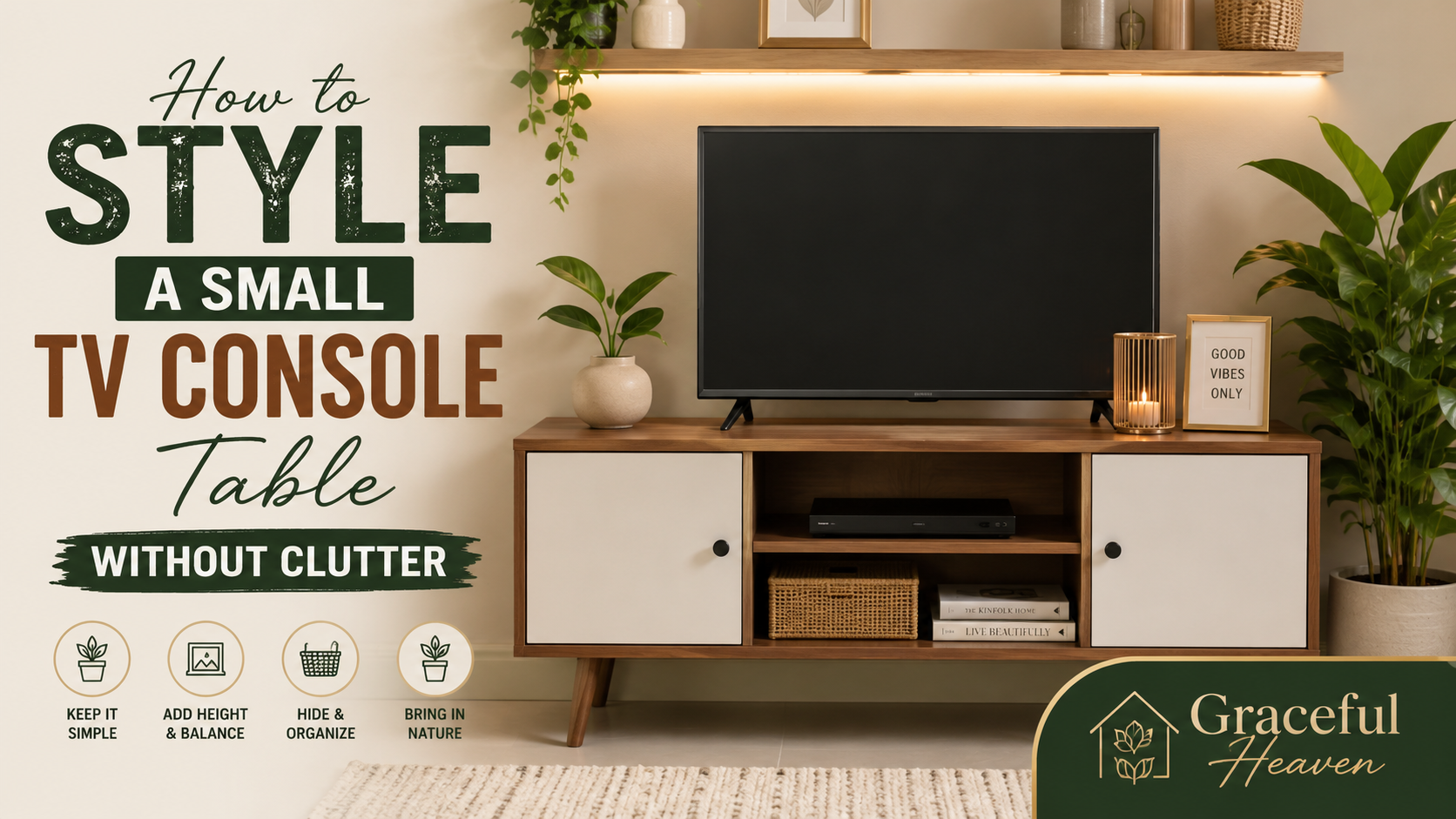
Picture this: a small stack of two or three books, topped with a tiny sculpture or a smooth stone. Next to it, a single tall vase with one or two dried stems. That’s it. That’s your whole decorative zone on one side of the table. Two “moments,” each built on the rule of three, with breathing room between them.
Why does this work so well on small tables specifically? Because restraint reads as intentional, and clutter reads as accidental. When there are only a few objects, each one gets to matter. When there are twelve objects, none of them do. 🕯️
Try this yourself: take everything off your console table right now. Seriously, clear it completely. Then add back only five or six items, total, spread across two small groupings. Live with that for a week before you add anything else. You’ll be shocked how much calmer the room feels.
Work Around the TV, Not Against It
The television is the elephant in the room, quite literally. It’s big, it’s dark, it’s rectangular, and it dominates the wall above your console. So don’t fight it. Design with it.
A common mistake: people try to “compete” with the TV by adding tall, busy decor that clutters the top of the table visually, right underneath the screen. This creates a crowded, top-heavy look, because now you’ve got a big black rectangle AND a chaotic little landscape sitting directly beneath it.
Instead, keep the area directly under the TV calmer than the rest of the table. Let the sides carry more visual weight. Think of the table in three zones: left, center, right. Center — right below the screen — should stay the emptiest. That’s where your eye naturally lands when the TV is off, so give it room to rest. 📺
If your TV is mounted on the wall and the console sits below with some gap, that gap is actually a gift. Use it. A low, horizontal piece of art or a slim decorative object can sit in that negative space without ever competing with the screen itself.
Scale Matters More Than You Think
Small table, small stuff, right? Actually — no. This is a common trap.
Tiny tchotchkes scattered across a small surface make it look busier, not cleaner. It’s the opposite of what people expect. A cluster of five miniature figurines takes up the same footprint as one nicely-scaled vase, but reads as ten times more chaotic.
So go bigger, fewer. One substantial object beats five small ones. A single ceramic vase, roughly 10 to 14 inches tall, will do more visual work — and create far less clutter — than a shelf’s worth of tiny collectibles crammed into the same space. 🏺
This feels counterintuitive at first. Won’t a big object overwhelm a small table? Not if you leave negative space around it. The empty space around an object is doing just as much work as the object itself. Designers call this “breathing room,” and it’s not decoration — it’s structure.
Color: Pick a Palette and Actually Stick to It
Clutter isn’t only about quantity. It’s also about visual noise, and color is a massive part of that.
If your decorative items are all different colors — a red candle, a blue book, a yellow ceramic bowl, a green plant — your eye has to work overtime just processing what it’s looking at. Even if there are only five objects, it FEELS like fifteen.
Pick two or three colors max for your console styling. Maybe it’s warm neutrals: cream, tan, a touch of brown wood tone. Maybe it’s a cooler palette: white, sage green, black accents. Whatever you choose, let every decorative object on that table live within that palette. 🎨
Books are the sneaky culprit here. Publishers love loud, colorful spines. So if you’re stacking books for height (great trick, by the way), turn them so the spines face inward, toward the wall, showing only the neutral page edges outward. Instantly, your “colorful book stack” problem disappears, and the stack becomes a clean, textural block instead of a rainbow distraction.
Real-World Scenario: The Family Living Room
Let’s make this concrete. Imagine a family with two kids, a dog, a gaming console, a streaming box, and a soundbar, all crammed onto a 36-inch console table.
That’s a LOT of functional gear for a small footprint. Here’s how you’d actually tackle it:
First, the gaming console and streaming box get grouped together on one side, tucked slightly behind the TV’s sightline, controllers stored in a fabric bin with a flap lid nearby (on a shelf below, if the table has one). Second, the remotes — because there are always at least three — go into a single small basket dead center, easy to grab, hard to lose. 🎮
Third, one side of the table gets a small styled moment: a plant in a simple pot, maybe six inches tall, paired with one framed photo laid flat rather than propped up, keeping the height low so it doesn’t compete with anything above it.
That’s the whole table. Gear, contained. Remotes, contained. One decorative touch, kept simple. No candles that’ll get knocked over by a running kid. No delicate glass anything within reach of a wagging tail.
This is what “styled” actually looks like in a real house. It’s not a showroom. It’s controlled chaos, organized just enough to feel calm.
Don’t Forget the Vertical Space Above
Here’s something people miss constantly: your console table doesn’t exist in isolation. It exists under a TV, often on a wall with room above and around it. Use that.
Floating shelves flanking the TV can absorb decorative overflow, pulling weight off the table itself. A tall plant in the corner, beside the console rather than on top of it, adds height and life to the whole setup without eating into your limited tabletop real estate. 🌿
Wall art, hung slightly above and to the side of the TV rather than directly centered over it, gives the eye somewhere else to travel besides the screen and the surface below it. This spreads the visual interest across the whole wall, not just concentrated onto one small table.
Think of your console table as one instrument in an orchestra, not the entire performance. When it’s carrying the full weight of “make this wall look good” all by itself, it’s going to look overstuffed no matter what you put on it.
The Weekly Reset Habit
Even the best-styled table falls apart without maintenance. This isn’t a one-time project. It’s a small habit.
Pick one day a week — Sunday evening works for a lot of people — and spend two minutes resetting the table. Remotes back in their basket. Stray mail relocated. Chargers coiled and tucked away.
Two minutes. That’s genuinely all it takes once the system is in place, because you’re not deep-cleaning or reorganizing from scratch. You’re just putting things back where they already belong. 🧹
Without this habit, even a perfectly styled table slides back into chaos within a couple of weeks. Systems only work if someone maintains them, and a two-minute weekly reset is about as low-effort as maintenance gets.
What to Actually Avoid
A quick gut-check list, because sometimes it helps to know what NOT to do.
Skip the oversized lamp on a small console — it eats the whole surface and leaves no room for anything else. Skip scented candles if pets or kids are nearby; they’re a clutter magnet AND a safety risk. Skip more than two “decorative moments” on one table; it starts competing with itself. And skip mismatched frame styles — three different photo frame finishes on one small table reads as disorganized, even if each frame individually looks nice. 🚫
None of these are hard rules carved in stone. But they’re the patterns that trip people up again and again, across totally different homes and totally different design tastes.
Bringing It All Together
Styling a small console table isn’t about owning fewer things. It’s about giving every single thing a job, a place, and a boundary. Functional items get contained in baskets, boxes, or drawers. Decorative items get grouped in small, height-varied clusters, kept within a tight color palette. The area under the TV stays calm. The scale goes bigger and fewer, not smaller and more.
Do that, and a table that used to feel chaotic starts to feel considered — even with the exact same amount of “stuff” living on it. Sometimes it’s not about removing things at all. It’s about finally giving them somewhere to belong.
So go ahead, clear that table off tonight, and start rebuilding it one small, intentional group at a time. Your future self, walking past it every single day, will thank you. ✨