Your living room feels cramped. You’ve got a couch, maybe a chair, a coffee table that’s doing double duty as a footrest and a junk drawer. And every time you try to add something pretty — a vase, a lamp, a little side table — it just looks like clutter instead of style. 🙃
Sound familiar?
Here’s the thing. Small rooms don’t need less personality. They need smarter personality. Accent pieces are the secret weapon of tiny living rooms, but only when they’re placed with intention. Throw them around randomly and you get chaos. Place them with a plan and suddenly your 12×14 box feels like a page out of a design magazine.
We’ve pulled together twelve practical, tested ways to style accent pieces in small living rooms. No fluff. No “just add plants and hope for the best.” Real strategies you can use this weekend. 🛋️
1. Pick One Hero Piece and Let Everything Else Support It
You don’t need five statement pieces fighting for attention in a small space. You need one.
Think about a boutique hotel lobby. There’s usually one showstopper — a sculptural chair, a bold piece of art, an oversized mirror — and everything around it is quiet. Calm. Supportive.
Choose your hero. Maybe it’s a vintage brass floor lamp. Maybe it’s a wildly patterned throw pillow that you’re obsessed with. Whatever it is, let it lead. Everything else in the room should be styled to complement it, not compete with it. This single move instantly makes a small room feel curated instead of crowded. ✨
2. Use the Rule of Odd Numbers
Groupings of three feel more natural to the eye than groupings of two or four. This is a design rule that’s been around forever, and it works.
So instead of two candles on your console table, try three, in different heights. Instead of two books stacked with a random object, do a trio: books, a small plant, a textured bowl. Odd numbers create visual rhythm. Even numbers can feel stiff, like a matched set from a catalog.
Try it tonight. Grab three small objects you already own. Group them close together on a shelf or table. Notice how much more “styled” it looks compared to scattering them evenly apart. 🕯️
3. Go Vertical When You Can’t Go Wide
Small rooms punish horizontal clutter. But height? Height is your friend.
A tall, skinny bookshelf takes up almost no floor space and gives you a whole vertical canvas for accent pieces. Stack books horizontally in one section, vertically in another. Add a small sculpture on top. Lean a piece of framed art against the back instead of hanging everything.
Floor lamps work the same magic. A slim arc lamp draws the eye up and away from a tight floor plan, making the ceiling feel higher than it actually is. Your room doesn’t get bigger. It just feels bigger. And honestly, that’s the whole game.
4. Mix Textures, Not Just Colors
A lot of people think styling is about color coordination. It’s really about texture.
Picture a room where every surface is smooth — glass table, leather couch, silk pillows. It looks nice in photos but feels cold in person. Now add a chunky knit throw, a rattan basket, a rough ceramic vase. Suddenly the room has warmth. Depth. Something to touch.
For small spaces, texture does heavy lifting that color can’t. A neutral palette with varied textures often reads as more sophisticated than a bold color scheme with flat, matching surfaces. Velvet. Wood grain. Woven fibers. Cool metal. Mix at least three textures into your accent pieces and watch the room come alive. 🧶
5. Anchor Every Grouping to a Surface, Not Empty Air
Nothing says “afterthought” like a random decorative object plopped in the middle of nowhere.
Every accent piece needs a job and a home. A stack of books needs a table under it. A sculpture needs a shelf. A candle needs a tray. This sounds obvious, but so many small living rooms have decor items floating without a clear surface anchoring them, which reads as messy even when the individual pieces are beautiful.
Before you place anything new, ask yourself: what surface is this living on? If you don’t have an answer, either find one or skip the piece for now.
6. Use Mirrors as More Than Just Mirrors
We all know mirrors make rooms look bigger. That’s not news.
But here’s what people miss: the frame around the mirror is an accent piece in itself. A carved wood frame, an aged brass edge, an asymmetrical modern shape — that frame does as much styling work as the reflective glass does.
Lean a large mirror against a wall instead of hanging it dead center. It creates a relaxed, collected-over-time look that feels intentional rather than staged. Prop a smaller mirror on your mantel or shelf alongside other objects. Let it reflect a lamp or a window. That double dose of light is what makes small rooms glow instead of feel dim. 🪞
7. Layer Your Lighting Like You Layer Your Outfit
One overhead light is not a lighting plan. It’s a compromise.
Small rooms especially need layered lighting because harsh overhead light flattens everything and makes the space feel smaller and more sterile. You want at least three light sources: ambient (overhead or natural), task (a reading lamp), and accent (a small uplight or candle glow).
A little table lamp with a warm bulb, tucked next to your favorite chair, does more for the mood of a room than any overhead fixture ever could. Add a dimmer if you can. Evenings feel completely different in a softly lit room. Trust us on this one. 💡
8. Let Books Be Decor, Not Just Storage
Your bookshelf shouldn’t look like a library card catalog. It should look like a curated little world.
Pull some books out and stack them flat instead of upright. Use them as risers under small objects — a plant, a candle, a tiny frame. Turn a few spines toward the wall if the colors are too busy or clashing. This trick alone transforms a chaotic bookshelf into something that looks deliberately styled.
Group books by color if you want a designer-magazine look. Group them by size if you want something more relaxed and lived-in. Either way, books are some of the cheapest, most versatile accent pieces you already own. 📚
9. Give Every Accent Piece Breathing Room
More isn’t better. Ever.
This might be the single hardest lesson for people to learn when styling a small space, because the instinct is to fill every gap. Resist it. Empty space, in design terms, is called negative space, and it’s doing just as much work as the objects themselves.
A shelf with three carefully placed items and visible gaps between them looks intentional. That same shelf crammed with ten items looks anxious, like it’s trying too hard. When in doubt, remove one thing. Then remove one more. Most rooms improve the moment you edit rather than add.
10. Repeat One Element Across the Room
Repetition creates cohesion. Without it, even beautiful individual pieces can feel disconnected from each other.
Pick one element — it could be a color, a material, or a shape — and echo it in at least three spots around the room. Maybe it’s brass: a lamp base, a picture frame, a small tray. Maybe it’s a specific shade of terracotta showing up in a vase, a pillow, and a small painting.
This is the trick interior designers use constantly, and it’s one of the easiest to replicate yourself. Your eye naturally connects repeated elements, even subconsciously, which makes a small collection of random objects read as a single, unified style story.
11. Style Your Coffee Table Like It’s a Tiny Stage
The coffee table is basically the centerpiece of most living rooms, so treat it that way.
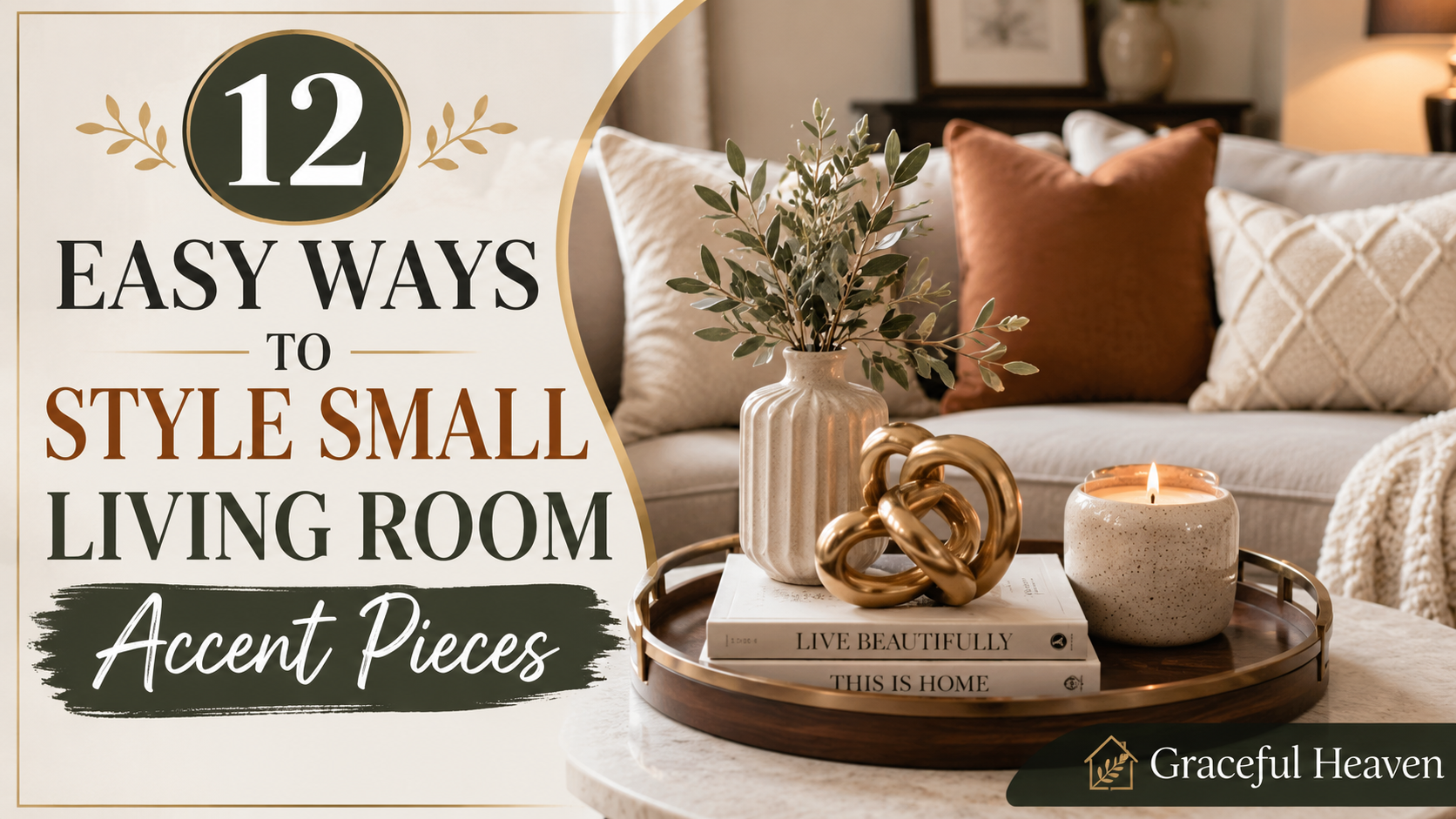
A tray helps contain everything and gives the eye a defined boundary to rest on. Inside that tray: a candle, a small stack of two or three books, one organic object like a small dish of stones or a mini plant. Keep the color palette tight — two or three tones max.
Leave room for actual living, too. Coasters. A remote. Space for your coffee cup. A coffee table that’s too precious to use isn’t styled well; it’s just impractical. Function and beauty need to share the stage here. ☕
12. Rotate Your Accent Pieces Seasonally
You don’t need to buy new decor every few months to keep your space feeling fresh. You need to rotate what you already have.
Store half your accent pieces in a closet or bin. Swap them out every season or every few months. This does two things: it keeps your eye from going numb to the same objects, and it lets you rediscover pieces you forgot you loved.
Think about it like a capsule wardrobe, but for your shelves. A smaller rotating collection styled thoughtfully will always beat a huge static collection that’s been sitting untouched for two years. Your living room stays interesting without costing you a dime. 🔄
Putting It All Together
None of these tips require a renovation or a big budget. Most of them just require rearranging what’s already sitting in your closets and drawers.
Start small. Pick two or three tips from this list — maybe the rule of odd numbers and the coffee table styling trick — and try them this weekend. See how the room feels afterward. Then build from there.
Small living rooms have a reputation for being limiting. They’re not. They’re just rooms that reward intention over accumulation. Every accent piece you place should earn its spot. Do that consistently, and your small space will feel bigger, warmer, and far more “you” than it ever did before. 🏡✨
Now go raid that junk drawer. There’s probably a great accent piece hiding in there already.