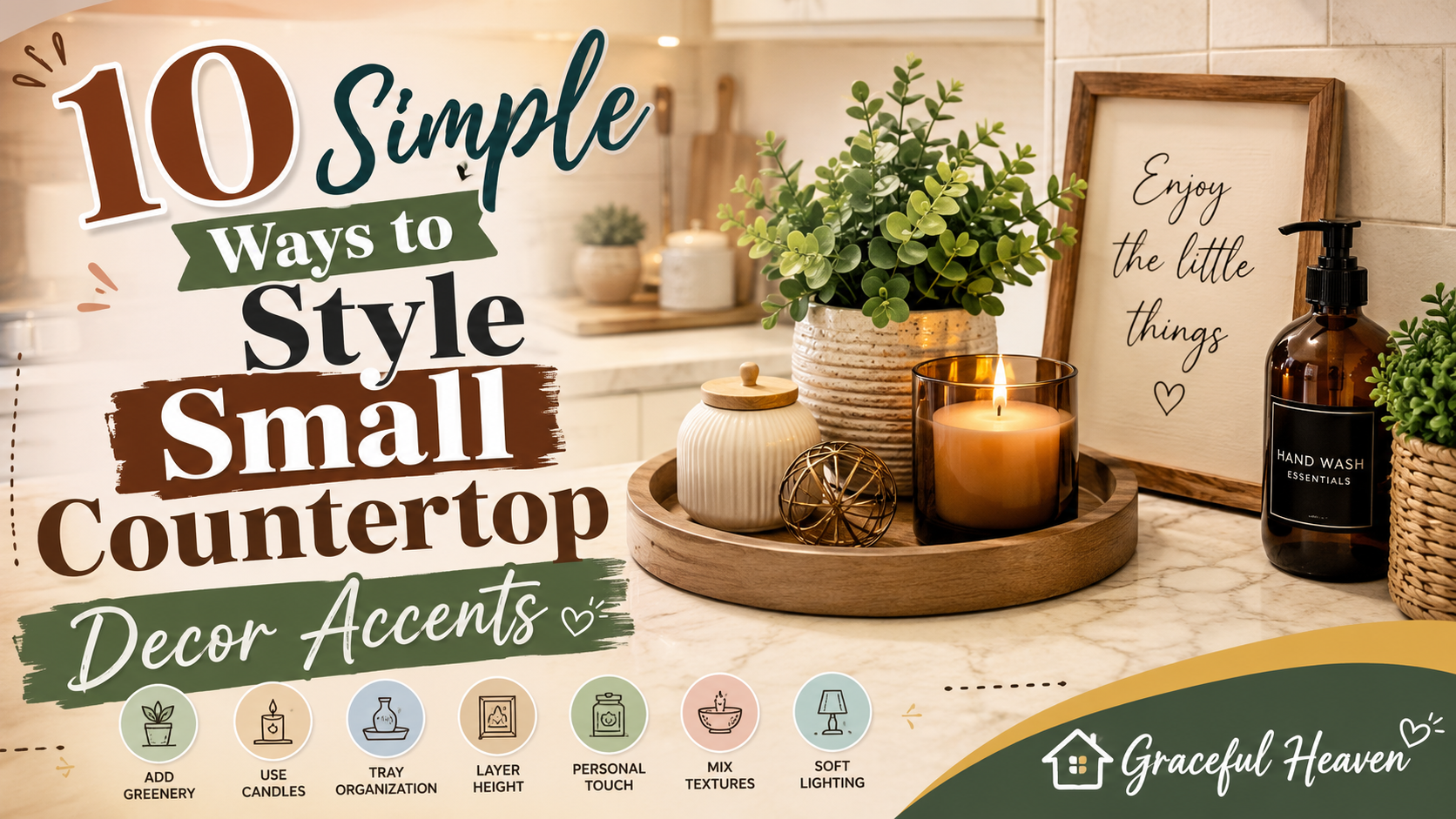
Your countertop is not just a workspace. It’s the first thing people notice when they walk into your kitchen. 🏠
And yet, so many of us treat it like an afterthought. A random dish here, a plant that’s slowly dying there, maybe a stack of mail that’s been sitting since last Tuesday. Sound familiar? 😅
Here is the thing: styling a countertop doesn’t require a design degree or a trip to some overpriced boutique. It just needs a bit of intention. A little bit of “why is this here?” thinking. That’s it.
So let’s talk about how to actually do it, without turning your kitchen into a showroom nobody’s allowed to touch.
1. Start With a Clean Slate (Seriously, Clear Everything Off) 🧹
Before you style anything, you need to see the canvas you’re working with.
Take everything off your counter. Everything. The blender, the fruit bowl, that weird ceramic thing your aunt gave you three Christmases ago. All of it, gone.
Now look at the empty space. Notice the material. Is it marble with soft gray veining? Butcher block with warm wood tones? Plain white quartz? This matters more than you’d think, because your decor should complement what’s already there, not fight against it.
Most people skip this step. They just start adding things back one by one, out of habit. But habit isn’t the same as design. Clearing the deck first lets you actually think.
2. Follow the Rule of Three (Odd Numbers Just Work) 🔢
Design nerds have known this forever: groupings of three feel more natural to the eye than groupings of two or four.
Think about it. Two items on a counter can look like a leftover pair. Four items can feel cluttered or too symmetrical, almost stiff. But three? Three feels curated. Intentional. Like you meant it.
Try this combo: a small vase, a stack of two cookbooks, and a single ceramic bowl. Vary the heights. Vary the shapes. That contrast is what makes the grouping interesting instead of flat.
You don’t need to obsess over this rule everywhere in your home. But on a countertop, where space is tight and every item is visible up close, it makes a real difference.
3. Use Height to Create Movement 📏
A flat countertop with everything at the same height looks boring. Almost lifeless, honestly.
You want your eye to move. Up, down, side to side. Not just sliding flat across the surface like it’s scanning a grocery receipt.
So mix your levels. A tall olive oil bottle next to a short stack of linen napkins. A small potted herb beside a low wooden tray. Even a cutting board propped upright against the backsplash adds vertical interest you wouldn’t get from laying it flat.
One trick professional stylists use? A small riser or stand. It costs almost nothing, but it instantly gives a short object more visual weight. Suddenly that little salt dish looks like it belongs there, not like it wandered in from somewhere else.
4. Bring in Something Alive 🌿
Plants change everything. Not exaggerating here.
A small potted herb, like basil or thyme, does double duty. It looks good, and you can actually use it when you’re cooking. Function and form, working together.
If you don’t trust yourself with a living plant (no judgment, we’ve all killed a succulent or two), a small bud vase with a single stem works just as well. Even a dried eucalyptus branch in a thin glass jar adds softness to what’s usually a hard, cold surface.
Here’s a quick scenario. Picture two identical kitchens. Same cabinets, same counters, same appliances. One has a small green plant near the sink. The other has nothing but empty stone. Which one feels more lived-in? More cared for? You already know the answer.
5. Let Your Everyday Items Do Double Duty 🍯
You don’t need to buy new “decor” for this. Your existing kitchen tools can be the decor.
That wooden spoon holder? Style-worthy, if it’s a nice material. Your olive oil in a glass cruet instead of the plastic bottle it came in? Instant upgrade. A ceramic canister of flour, sitting out instead of hidden in a cabinet, adds texture and warmth.
This approach saves money. It also keeps your counter functional instead of purely decorative, which matters if you actually cook in your kitchen (and let’s be honest, most of us do).
Swap out plastic and mismatched containers for a few cohesive ones. Glass, wood, ceramic. Pick two or three materials max and stick with them. Consistency does a lot of heavy lifting here.
6. Play With Trays to Corral the Chaos 🍽️
A tray sounds like such a small thing. But it changes how a whole grouping reads.
Without a tray, three or four items just look scattered. Random. With a tray underneath them, suddenly they’re a set. A collection. Something you clearly put together on purpose.
Wooden trays feel warm and rustic. Marble trays feel sleek and modern. Woven rattan trays add a relaxed, almost coastal vibe. Pick one that matches the mood you’re going for.
Trays also make cleaning easier, by the way. Need to wipe the counter? Just lift the whole tray, wipe underneath, put it back. No fussing with fifteen individual items.
7. Don’t Forget About Scent 🕯️
Decor isn’t only visual. It’s an experience.
A small candle in a simple glass jar does more than look nice sitting there. It adds a layer of ambiance you can’t get from anything purely decorative. Light it during dinner prep, and suddenly cooking feels less like a chore.
If open flame near your cooking zone makes you nervous (totally fair), try a small reed diffuser instead. Same effect, zero fire risk.
Keep the scent subtle though. You’re cooking in this space. Nobody wants their pasta sauce fighting with a heavy vanilla candle for dominance in the air. Go light. Go clean. Citrus, herbal, or unscented candles work best near food prep areas.
8. Anchor Everything With a Cutting Board 🪵
This one surprises people. A cutting board, just leaned against the backsplash, does more visual work than you’d expect.
It adds warmth if it’s wood. It creates a backdrop for smaller items sitting in front of it. And unlike most decor, it’s actually useful, so you’re not adding clutter for clutter’s sake.
Lean it slightly at an angle rather than flat against the wall. That small tilt makes it look intentional rather than forgotten there. Group a small bowl of lemons or a bundle of dish towels in front of it, and you’ve got a whole little scene.
9. Color Coordinate, But Don’t Overdo It 🎨
Pick a color story. Two, maybe three colors max. Then let everything you place on the counter fall somewhere within that palette.
Say your kitchen leans warm and earthy. Terracotta, cream, sage green. Your accents should echo that. A cream ceramic bowl. A terracotta pot for your herbs. A sage green dish towel folded neatly nearby.
What you want to avoid is a rainbow explosion. A red dish towel next to a blue vase next to a yellow bowl. Individually, each piece might be lovely. Together, it’s visual noise.
This doesn’t mean everything has to match perfectly, like a matching furniture set from a big box store. That looks stiff, almost showroom-fake. You want harmony, not uniformity. Different shades within the same family. Different textures within a shared tone.
10. Rotate Seasonally to Keep It Feeling Fresh 🍂❄️🌸☀️
Static decor gets stale. Even great styling starts to fade into the background if it never changes.
So swap things out. Small gourds and warm-toned candles in the fall. A simple bowl of citrus in winter, when everything else feels gray and cold. Fresh flowers in spring. A pitcher of something cold and a bowl of stone fruit in summer.
This doesn’t need to be a whole overhaul every few months. Swap one or two pieces. That’s enough to keep the space feeling current, feeling noticed, feeling like someone actually lives there and pays attention.
Honestly, this is the step most people skip entirely. And it’s the one that keeps a kitchen from feeling like a photo from five years ago that nobody’s updated since. 📸
A Few Mistakes to Watch Out For ⚠️
Before you go rearrange your whole kitchen, a couple quick warnings.
Don’t overcrowd. This is the single biggest mistake people make. More items does not mean more style. It usually just means more clutter, and more stuff to move every time you actually need to cook. Less, done thoughtfully, always beats more, done carelessly.
Don’t ignore scale. A tiny bud vase on a massive marble island can look lost, almost lonely. Match your item sizes to the size of your counter space.
And don’t forget your daily workflow. If you cook every night, don’t pile decor right where your cutting board needs to go. Function first. Style second. Always.
Bringing It All Together 🔗
None of this requires a big budget. It requires attention.
Walk into your kitchen right now. Look at your counter with fresh eyes, like you’re seeing it for the first time. What’s serving a purpose? What’s just sitting there out of habit? What could use a little height, a little color, a little life?
Start small. Pick one tip from this list. Try it this weekend.
You might be surprised how much a little intention can change the whole feel of a room you walk through every single day. ✨