That empty corner by your window has been bothering you for weeks. 📚
Maybe it’s a leftover space nobody planned for. Maybe it’s the awkward gap next to your couch that always seems to collect junk mail and phone chargers. Either way, a small bookshelf can turn that dead zone into the best-looking part of your room. You don’t need a huge library or a pile of rare first editions to make it work. You just need a plan.
So let’s get into it. Here are twelve ways to style a small bookshelf corner that actually look good — not staged, not sterile, just genuinely nice to look at every day.
1. Stop Organizing by the Alphabet 🔤
Alphabetical order feels responsible. It also feels boring.
Try grouping books by color instead, or by mood, or even by how much you loved them. A shelf where all your favorite paperbacks sit together tells a better story than one sorted by author’s last name. Think about it — when was the last time you walked into a friend’s living room and thought, “Wow, look at that impeccable A-to-Z system”? Never. You noticed the colors, the textures, the little objects tucked between the spines.
Color grouping works especially well on small shelves because it creates visual rhythm without needing extra decor. Blues fading into greens. Warm oranges next to deep reds. It’s an easy win.
2. Mix Vertical and Horizontal Stacks 📐
Here’s the thing about small shelves: symmetry kills them.
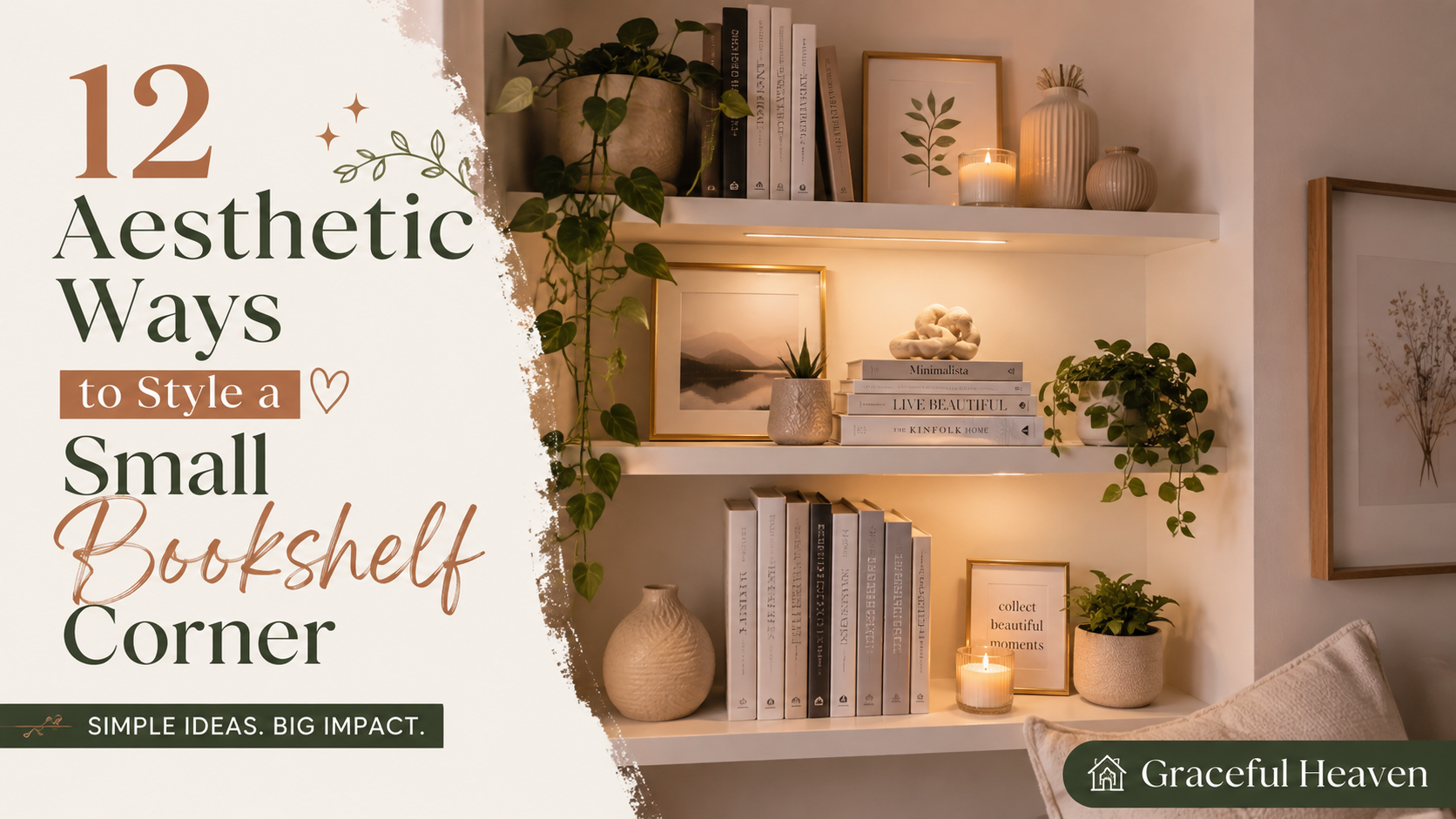
If every single book stands upright, the whole thing reads flat. Boring, even. Lay a few books flat and stack them two or three high, then let a small plant or a framed photo sit on top. This breaks the monotony and adds height variation, which is basically the secret sauce of good shelf styling.
A quick example. Say you’ve got a shelf that’s three feet wide. Instead of lining up ten books shoulder to shoulder, try this: five upright on the left, a horizontal stack of three on the right topped with a tiny ceramic dish, and one lone oversized book leaning against the side wall of the shelf. Suddenly it looks curated instead of crammed.
3. Let Negative Space Do Some Work 🌬️
You don’t have to fill every inch.
Empty space isn’t wasted space — it’s breathing room. Designers call this “negative space,” and it’s what separates a gallery-worthy shelf from a cluttered one. If your small bookshelf only has three shelves, consider leaving one section deliberately sparse. One book. One small object. That’s it.
It feels counterintuitive at first, especially if you’re the type who wants to use every available surface. But trust the process here. A shelf that’s 70% full often looks more expensive and intentional than one that’s stuffed to the edges.
4. Bring In Something Alive 🌿
Books and plants are basically best friends.
A small trailing plant, like a pothos or a string of pearls, softens all those hard lines and straight edges. It also adds a pop of color that doesn’t compete with your book spines. Even a tiny two-inch succulent tucked into a small pot can shift the whole vibe of a shelf from “storage” to “styled.”
No green thumb? No shame in that. A well-made faux plant works fine here, honestly nobody’s checking.
5. Anchor It With One Standout Object 🏺
Every good shelf has a hero piece.
This could be a small sculpture, a vintage camera, a chunky candle, or even a single striking bookend shaped like something unexpected — a hand, a bird, a geometric block. The goal is one object that catches the eye before anything else does. Without a focal point, your eye just kind of wanders and never lands anywhere.
Pick something with a bit of weight or texture. Matte ceramic, aged brass, rough stone — these materials contrast beautifully against the flat surfaces of book covers.
6. Use Trays to Corral the Small Stuff 🪞
Tiny objects scattered across a shelf look messy fast.
A small wooden or brass tray gives loose items — matchboxes, rings, little stones you picked up on vacation — a home. It groups them visually so they read as one intentional vignette instead of five random things someone forgot to put away.
This trick works because our brains like patterns. A tray creates a boundary, and boundaries make clutter look organized, even when it technically isn’t.
7. Layer in Texture, Not Just Color 🧶
Color gets all the attention, but texture is doing quiet, important work.
Add a small woven basket, a rough stone bookend, or a piece of driftwood. These natural textures contrast with the smoothness of book covers and glass frames, giving the shelf more depth. A shelf that’s all smooth surfaces — glossy book jackets, glass, polished wood — can start to feel a little flat and showroom-ish.
So mix it up. Rough next to smooth. Matte next to shiny. That contrast is what makes a small space feel rich instead of thin.
8. Frame a Tiny Piece of Art 🖼️
You don’t need wall space for art if you’ve got shelf space.
A small framed print, postcard, or even a piece of your kid’s artwork can lean against the back of the shelf instead of hanging flat on the wall. Leaning art has a relaxed, lived-in quality that hung art just doesn’t have. It also gives your eyes a vertical break among all those horizontal book spines.
Try layering two small frames slightly overlapping. It looks like it happened naturally, even though you’ll probably spend ten minutes nudging them into place. That’s fine. Nobody has to know.
9. Play With Height Using Books as Pedestals 📚
Books aren’t just reading material here — they’re furniture.
Stack two or three hardcovers and set a small object on top, like a candle or a mini vase. This instantly creates height variation, which, as we mentioned, is one of the biggest visual tricks for making a small shelf feel dynamic. Flat, single-level arrangements tend to look like they belong in a waiting room. Layered ones look like they belong in a magazine.
Pick books with interesting spine colors or textures for this trick since they’ll be doing double duty as both reading material and decor.
10. Add Warm, Low Lighting 💡
A shelf in full daylight is nice. A shelf glowing softly at night? That’s something else entirely.
A small battery-operated LED strip, tucked along the underside of a shelf, adds a warm glow that makes everything on display look intentional, almost gallery-lit. Even a tiny plug-in string of fairy lights woven between books can do the trick. This is a cheap fix, but it makes a genuinely big difference once the sun goes down.
Skip anything too bright or blue-toned. Warm white is the way to go if you want that cozy, bookstore-at-dusk feeling.
11. Don’t Ignore the Base of the Shelf 🧺
The bottom shelf is often the forgotten one. Don’t let it be.
Since it’s usually lower and less visible, people tend to just shove baskets or random storage bins down there without a second thought. But this spot has real potential. A woven basket with a folded throw blanket, or a stack of oversized coffee table books, can anchor the whole unit and give it a grounded, finished look from top to bottom.
Think of the bottom shelf as the foundation of a good outfit — it doesn’t need to be flashy, but it needs to hold everything else together.
12. Rotate Your Display Seasonally 🍂
Here’s a tip most people never think about: your shelf shouldn’t be static.
Swap out a few objects every couple of months. Bring in a small pumpkin or pinecones in the fall. A tiny vase of fresh flowers in spring. This keeps the space feeling alive and prevents that “I haven’t touched this in a year” dustiness that even nice shelves can fall into over time.
It doesn’t take much. Even changing two or three items can make the whole corner feel refreshed, almost like you redecorated the entire room.
A Quick Word on Making It Actually Yours
None of these ideas work as a strict checklist. 🎯
You don’t need to hit all twelve points on one small shelf — that would actually look chaotic. Pick three or four that fit your space and your personality, then build from there. Maybe you’re someone who leans hard into plants and warm lighting. Maybe you’re more of a color-blocking, bold-object kind of person. Both are right.
The real trick to styling any small space is restraint mixed with a little personality. Too styled, and it feels like a showroom nobody actually lives in. Too cluttered, and it feels like storage that got out of hand. The sweet spot sits somewhere in between — a shelf that looks put together but still feels like you live there.
So go stand in front of that corner again. Look at what you’ve got. Pick two or three books you actually love, one object that means something, maybe a small plant if you’re feeling ambitious. Start small, adjust as you go, and let the shelf grow into itself over time. 🌟