Your coffee table has a problem. It’s either bare and boring, or it looks like a junk drawer exploded on top of it. 😅
There’s rarely an in-between. Remote controls slide off. Coasters go missing. Candles tip over when someone puts their feet up. A tray fixes almost all of that — but only if you actually style it right.
Most people just toss stuff on a tray and call it done. That’s not styling. That’s just relocating clutter to a nicer platform. 🙃
So let’s talk about how to actually make a small tray work for you, not against you.
Why a Tiny Tray Makes Such a Big Difference
Here’s the thing. A coffee table without a tray is basically an open invitation for chaos.
Mail lands there. Phone chargers pile up. Your kid’s crayons somehow migrate onto it, and nobody remembers how. A tray creates a boundary — a visual “this stuff belongs together” zone that your eye reads as intentional, even if what’s inside it is genuinely random. 📦
Think about it like a picture frame. The same photo looks scattered and messy pinned loosely to a wall. Frame it, and suddenly it looks curated. Trays do that for your coffee table.
Small trays specifically are having a moment right now, and for good reason. Not everyone has a giant table. Apartments are getting smaller. Ottomans are trendy again, and they need something proportional sitting on top of them. A small tray, styled well, punches way above its size.
Let’s get into the six ways that actually work.
1. The Rule of Three (And Why It Actually Works)
Designers won’t shut up about the rule of three. Annoying? Maybe. Wrong? Not really.
Odd numbers of objects feel more natural to the human eye than even ones. Two items look like a matched pair, stiff and symmetrical. Three items create movement. Your eye travels between them instead of just landing flat.
So on a small tray, this could look like:
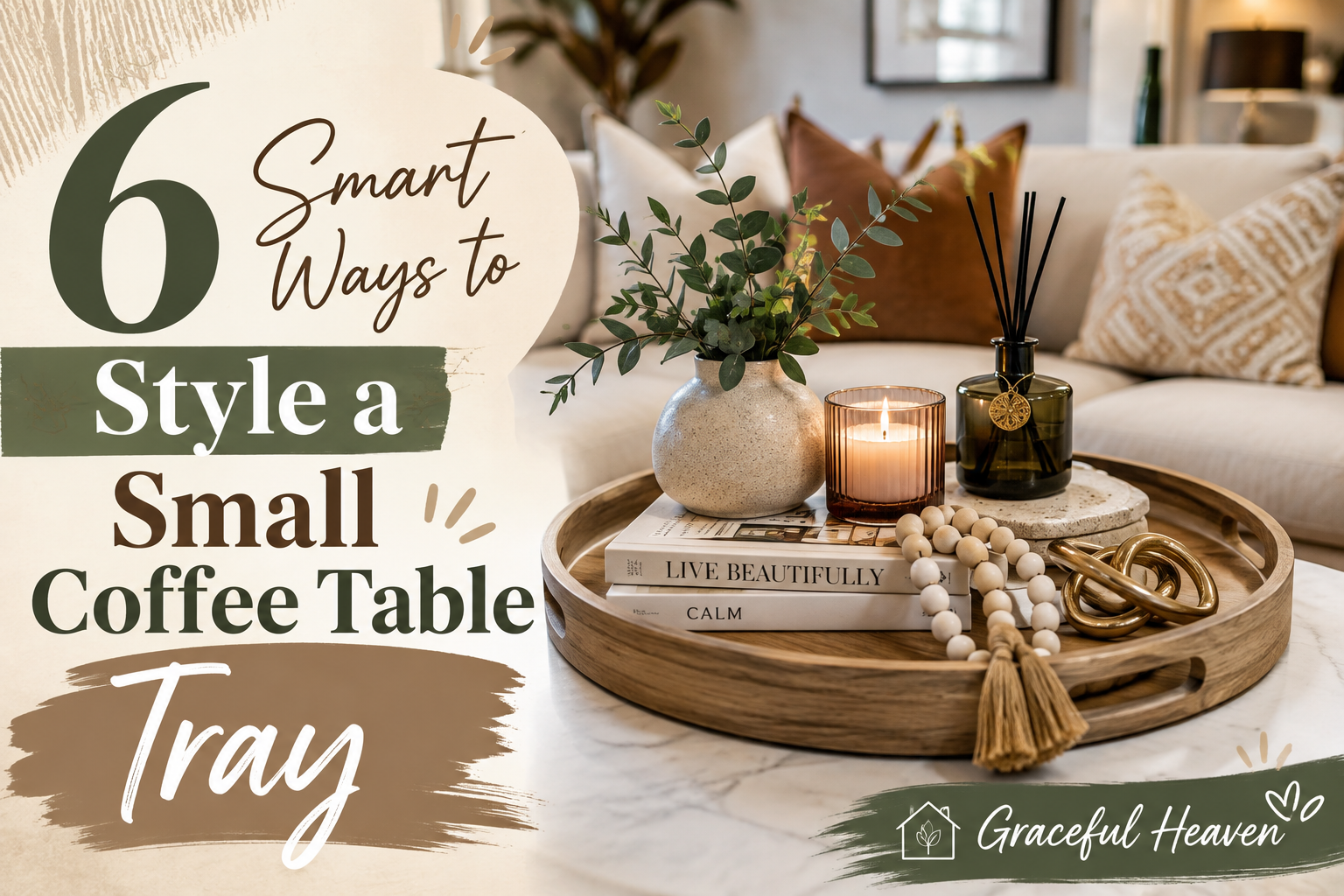
- A short stack of two or three books 📚
- A small vase with a single stem or dried branch
- One tactile object — a stone coaster, a little bowl, a candle
That’s it. Resist the urge to add a fourth thing “just because there’s room.” There usually isn’t as much room as you think, and small trays punish overcrowding fast.
A quick scenario for you. Say you’ve got a 12×16 inch tray on an ottoman. Put a stack of two hardcovers on one side, angled slightly, not perfectly straight. Add a small ceramic bud vase next to it, maybe four inches tall. Then a single smooth stone or a tiny brass dish for keys. Done. You’ve used the rule of three and it took ninety seconds. ⏱️
2. Play With Height Like You’re Building a Skyline
Flat trays are dead trays. Everything the same height reads as flat, even if the individual objects are pretty.
You want variation — tall, medium, short. Like a mini skyline sitting on your table.
A candle in a taller holder gives you height. A stack of two books gives you medium. A small dish or a single orange sitting loose gives you low. Suddenly there’s rhythm to it, and rhythm is what separates “styled” from “placed.”
Here’s a trick most people skip: use risers. A tiny wooden block or an upside-down teacup under an object adds height without adding bulk. Nobody notices the riser. They just notice the tray “looks nice,” without knowing why. 🕯️
Books are honestly your best friend here, and not just for reading value. Their spines add color, their thickness adds height, and stacking two or three at slightly different angles gives instant visual interest for basically zero cost.
3. Anchor It With One “Hero” Object
Every good tray needs a main character. 🎭
Without one, your eye doesn’t know where to land first. It just bounces around, and that reads as cluttered even when the actual number of items is small.
The hero object should be the biggest, most visually interesting, or most colorful piece on the tray. Everything else supports it. A ceramic vase with dramatic dried pampas grass, for instance. Or a striking marble bowl. Or even a single, really beautiful coffee table book with a bold cover.
Once you pick the hero, arrange everything else around it, not competing with it. If your hero is tall, keep the supporting cast shorter. If your hero is bold and colorful, keep the rest more neutral so it doesn’t fight for attention.
This one sounds obvious. But it’s the single most common thing people skip, and it’s the reason so many trays feel “off” without anyone being able to say why.
4. Match the Tray to the Mood of the Room, Not Just the Table
A lot of people style the tray in isolation. Wrong move.
Your tray is not decorating itself in a vacuum — it’s part of a room that already has a personality. Warm and cozy? Minimal and modern? Boho and layered? The tray should echo that, not fight it. 🛋️
If your living room leans warm and rustic, a woven rattan tray with a small stack of linen-bound books and a terracotta candle holder will feel right at home. Put a sleek black lacquer tray with acrylic accessories in that same room, and it’ll look like it teleported in from a completely different apartment.
On the flip side, if your space is more modern minimalist, a marble or matte metal tray with one striking object and a lot of negative space will feel intentional. Add three trinkets and a plant and a candle to that same setup, and suddenly it looks cluttered, even though objectively it’s not that much stuff.
Quick gut-check before you style anything: stand at your doorway and look at the room as a whole. Does your tray idea fit the vibe you’re already seeing? If not, adjust before you commit.
5. Use Negative Space Like It’s an Ingredient
This one trips people up the most, especially on small trays.
Empty space is not wasted space. It’s part of the design. 🌬️
When every square inch is filled, nothing gets to breathe, and your eye can’t rest anywhere. A tray with some open tray-surface visible actually looks more expensive and more intentional than one crammed edge to edge.
Try this test. Style your tray the way you normally would. Then remove one item — just one. Look at it again. Nine times out of ten, it looks better. That empty little patch of tray surface does more work than the object you just took away.
This matters even more on small trays because there’s so little real estate to begin with. A 10-inch tray with four items looks busy. The same tray with two items, spaced with intention, looks like something out of a catalog.
Less isn’t just more here. Less is often the entire point.
6. Rotate With the Seasons (Or Just Your Mood)
Your tray shouldn’t be static forever. Static trays get invisible. You stop seeing them, and so does everyone else. 🍂
Swapping out even one or two elements every few weeks keeps the whole thing feeling fresh, and it doesn’t cost much. Trade the summer candle scent for something warmer in the fall. Swap the vase’s greenery when it starts wilting. Bring out a small pumpkin in October, or a tiny stack of holiday cards in December.
This isn’t about buying a whole new set of tray decor every season. It’s about small, low-effort swaps that reset the whole look.
Here’s a scenario. Say your everyday tray has a candle, a small stack of books, and a plain glass vase. For fall, swap the plain vase for one with a couple of dried wheat stems. Swap the candle scent to something like amber or cedar. That’s two changes, five minutes of effort, and the whole tray suddenly feels seasonal without looking like a Pinterest board threw up on your ottoman. 🍁
A Few Small Mistakes That Undo All This
Quick gut-check list before you call your tray “done”:
- Don’t use anything too tall that blocks the TV or conversation across the room
- Don’t mix more than two or three materials — wood, ceramic, glass is plenty
- Don’t forget function. If you actually use coasters or a remote, leave room for them
- Don’t glue yourself to symmetry. Perfectly centered objects look staged, not lived-in
Small tweaks. Big difference.
Putting It All Together
None of these six ideas require a shopping trip. Look around your own house first. That stack of books on your nightstand? Borrow two for the tray. That little bowl your grandmother gave you that’s been sitting in a drawer? Perfect low-height piece. Half the “styled” look people pay for is just rearranging what they already own with a little more intention. 🏡
Start small. Pick one tray, one shelf’s worth of test objects, and give yourself ten minutes. Try the rule of three. Add some height variation. Pick a hero object. See how it feels.
You’ll probably end up removing more than you add — and that’s exactly the point.