That little round table in the corner is staring at you. Empty. Boring. Kind of sad, honestly. 😅
You don’t need a $200 budget to fix this. You need a plan, some patience, and maybe a trip to a thrift store. That’s it.
A small round side table is one of the easiest pieces of furniture to style, but people overthink it constantly. They picture a Pinterest board with matching ceramics and imported candles. Then they get overwhelmed. Then they do nothing, and the table stays empty for another six months. Sound familiar?
Let’s break this down into something actually doable. 🛠️
Start With What the Table Actually Needs
Before you buy a single thing, ask yourself: what job does this table have?
Is it holding your coffee mug every morning? Is it next to your reading chair, waiting for a lamp and a stack of books? Or is it purely decorative, tucked in a hallway where nobody sits down?
This matters more than people realize. A functional table needs functional objects on it. A purely decorative one has more room to play. Figure out the job first. Everything else follows from there.
The Rule of Odd Numbers (And Why It Works)
Here’s a design trick that costs nothing: group items in odd numbers. Three items. Five items. Never four.
Why? Symmetry feels static. Odd numbers create a visual triangle, and your eye naturally moves around the grouping instead of locking onto one flat line. Interior designers use this constantly, and it works on a $500 table just as well as it works on a $5 table from a yard sale.
So instead of two candles and a photo frame (four objects, flat and boring), try one candle, one small plant, and a stack of two books. That’s five distinct visual points, but grouped as three “clusters.” Your brain reads it as balanced, even though nothing matches perfectly. 🎯
Height Variation Is Your Best Friend
Flat surfaces with flat objects look, well, flat. Boring. Forgettable.
You want at least one tall element, one medium, and one low. Think of it like a skyline. A tall lamp or vase in the back, something medium height in the middle, something low and wide in front. This creates depth even on a table that’s only 18 inches wide.
Don’t have a tall object? Stack two books and put a small item on top. Instant height variation, and it cost you nothing because those books were already on your shelf.
Thrift Stores Are Your Secret Weapon
Let’s talk money now, because that’s why you’re here. 💰
Thrift stores and secondhand shops are absolute goldmines for side table decor. People donate ceramic bowls, brass candlesticks, small vases, and picture frames constantly, usually because they redecorated or downsized. These items are often solid brass, real ceramic, or actual wood. Not the flimsy stuff you’d find at a big box store for triple the price.
Go in with an open mind. Don’t search for “a blue vase.” Search for “anything with a nice shape or texture.” You can always spray paint a mismatched item to fit your color scheme later, and that costs about four dollars a can.
Here’s a quick real-world example. Say you find a chipped ceramic bowl for a dollar at Goodwill. The chip is small, near the base, barely visible once it’s on the table. You buy it. At home, you fill it with a few dried orange slices or pinecones from your yard. Total cost: one dollar plus whatever you already had lying around. That bowl now looks intentional, styled, almost editorial.
Nature Doesn’t Send an Invoice
Plants and natural elements are the cheapest decor trick in existence, and somehow people forget this every single time. 🌿
A small potted succulent costs a few dollars and adds life, texture, and color without trying too hard. Don’t want to deal with plant maintenance? Grab a few eucalyptus stems or dried pampas grass from a craft store. They last for months and require zero water.
Even simpler: walk outside. Seriously. A few smooth stones, a small branch, some pinecones in autumn. Free decor, and it looks curated because natural textures always read as intentional, never accidental.
One friend of mine kept a small glass jar filled with beach glass she’d collected over three summers. Cost her nothing but a walk on the shore. That jar became the centerpiece of her side table, and guests always asked about it. That’s the kind of story your decor should tell. Not “I bought this at a store,” but “here’s where this came from.”
Candles: Cheap, Effective, Slightly Underrated
A candle does double duty. It’s decor during the day and ambiance at night. Win-win. 🕯️
You don’t need luxury candles from a boutique. Dollar store pillar candles work fine, especially in neutral colors like cream, sage, or terracotta. Place one on a small saucer or tray to make it feel more finished, more “put together.”
If you want it to feel a bit more elevated, buy a plain glass candle and wrap the base in twine or a strip of fabric scrap. Takes two minutes. Costs almost nothing. Suddenly it looks handmade, artisanal, like something from an expensive home goods store.
Trays Create Instant Structure
This one small trick changes everything: put a tray under your grouped items.
A tray does something psychological. It tells your brain “these items belong together,” even if they’re wildly mismatched in style or color. It also protects the table surface and makes cleaning easier, since you can lift the whole grouping at once.
You don’t need a fancy tray either. An old picture frame with the glass removed works. A wooden cutting board you’re not using anymore works. Even a flat ceramic plate can function as a tray for smaller items. Get creative here.
Books Aren’t Just for Reading Anymore
Old books, especially hardcovers with worn or plain spines, are fantastic decor tools. Stack two or three, largest on the bottom, and you’ve instantly added height and texture for free.
Here’s a tip nobody tells you: turn the books so the pages face outward instead of the spines. This works especially well if your books have mismatched or clashing cover colors. Suddenly you’ve got a clean, neutral base of cream-colored pages instead of a jumble of competing titles and fonts.
Top the stack with a small object. A tiny vase. A smooth stone. A miniature plant. This is the classic “styled stack” you’ve probably seen a hundred times online, and it works because it’s simple, cheap, and endlessly adaptable.
Color Coordination Without Buying New Things
You don’t need everything to match perfectly. You need everything to feel like it’s speaking the same language.
Pick two or three colors max for your table vignette. Maybe cream, sage green, and a touch of gold. Then look around your house. Do you already own things in these tones? A small dish, a candle, a picture frame you forgot about in a closet? Pull them together before buying anything new.
This is the step people skip, and it’s the most important one. Shopping without a color plan means you’ll come home with a bunch of pretty but unrelated objects that don’t actually work together. Ten extra minutes of planning saves you money and frustration later.
The Power of a Single Statement Piece
Sometimes less really is more. One striking object can do more work than five small trinkets combined.
Maybe it’s a chunky ceramic vase you found at an estate sale. Maybe it’s a small piece of art propped up against the wall behind the table. One statement piece, styled simply with maybe one or two supporting objects, can look more expensive and more intentional than a cluttered arrangement of five mismatched knick-knacks.
Think about hotel lobbies for a second. Notice how the side tables there often have just one elegant object, maybe a small sculpture or a single orchid? That’s not because they’re being cheap. It’s because restraint looks luxurious. You can absolutely borrow this trick at home, and it costs you less than filling the table with clutter would.
DIY Projects That Actually Look Good
Not all DIY looks homemade in a bad way. Some DIY projects look genuinely polished if you’re patient with the details.
Try this: take a plain glass jar, wrap the middle third in jute rope, and glue it down carefully. Fill it with dried flowers or fairy lights. This costs about five dollars in materials and looks like something from an expensive boutique.
Or paint a thrifted vase in a matte finish using leftover craft paint. Matte finishes photograph beautifully and hide imperfections in cheap ceramic far better than a glossy finish would. Two coats, a few hours of drying time, and you’ve transformed a dollar-store reject into something that looks custom made.
Seasonal Swaps Keep Things Fresh
Here’s the thing about decor: it doesn’t need to be permanent. 🍂❄️🌸☀️
Rotate small seasonal touches throughout the year instead of buying a whole new set of decor every few months. Pinecones and cinnamon sticks in fall. A few sprigs of holly or pine in winter. Fresh tulips or a pastel ribbon in spring. A small dish of shells or a citrus-scented candle in summer.
This keeps your table feeling alive and current without any major expense. You’re just swapping small, cheap elements in and out of an existing structure you already built. The tray stays. The candle stays. Just the small seasonal touch changes.
What to Avoid (Common Cheap-Decor Mistakes)
Let’s talk about what not to do, because this matters just as much.
Don’t overcrowd the table. A small round table has limited real estate, and cramming too many objects onto it just reads as cluttered, not styled. Less really is more here.
Don’t ignore scale. A tiny two-inch trinket on a table meant to hold a lamp will look lost and accidental. Match your object sizes to the table’s actual footprint.
Avoid mismatched materials that clash hard, like a rustic wood bowl sitting next to a super shiny chrome frame, unless you’re intentionally going for an eclectic look and you know how to pull it off. If you’re not sure, stick to two or three materials max. Wood, ceramic, and glass work well together. Chrome and rustic wood, less so, unless styled very carefully.
And please, don’t forget function. If people actually set drinks or books on this table, don’t fill every inch with decor. Leave breathing room for real use, or you’ll just end up shoving everything aside constantly, which defeats the whole purpose.
A Quick Sample Layout (Copy This If You’re Stuck)
Need a starting point? Here’s a layout that works on almost any small round table, budget-friendly and easy to source.
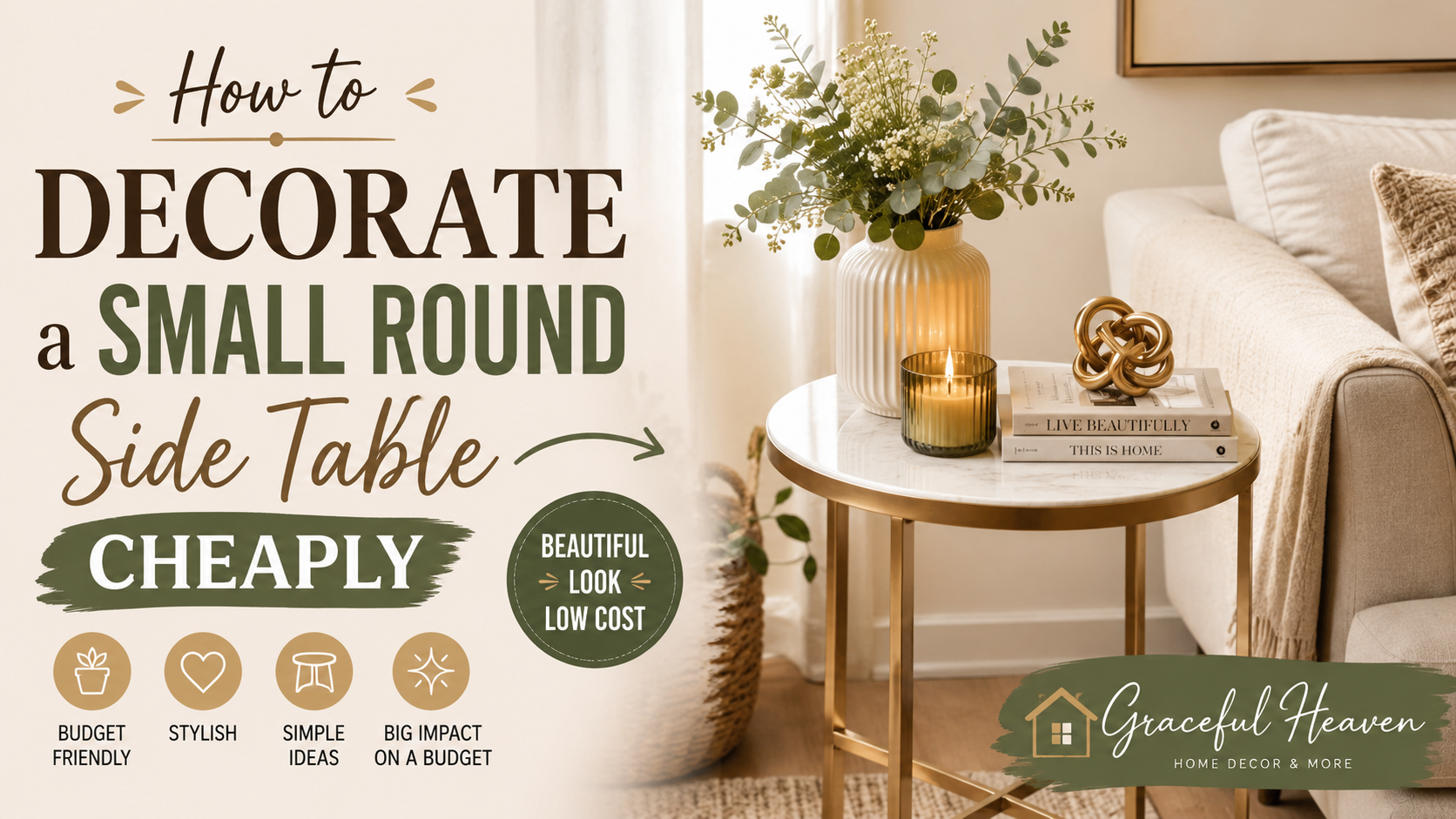
One small thrifted ceramic vase, painted matte white. One stack of two hardcover books, pages facing out. One small potted succulent or a few dried stems in a tiny glass jar. All placed on a simple round tray, maybe a wooden one you already own or picked up for a few dollars.
Total potential cost, if you’re buying everything secondhand or from a dollar store: under fifteen dollars. Total visual impact: honestly, way more than that. 🌟
Small Table, Big Personality
Your side table doesn’t need a designer price tag to look intentional. It needs thought, a little creativity, and honestly, just five minutes of rearranging what you already own.
Go look at that empty table right now. Grab three things from around your house. A book, a small dish, something with a little height. Group them in odd numbers, vary the height, and see what happens.
You’ll probably be surprised how much better it looks in under ten minutes. And that’s really the whole point, isn’t it? 😊