
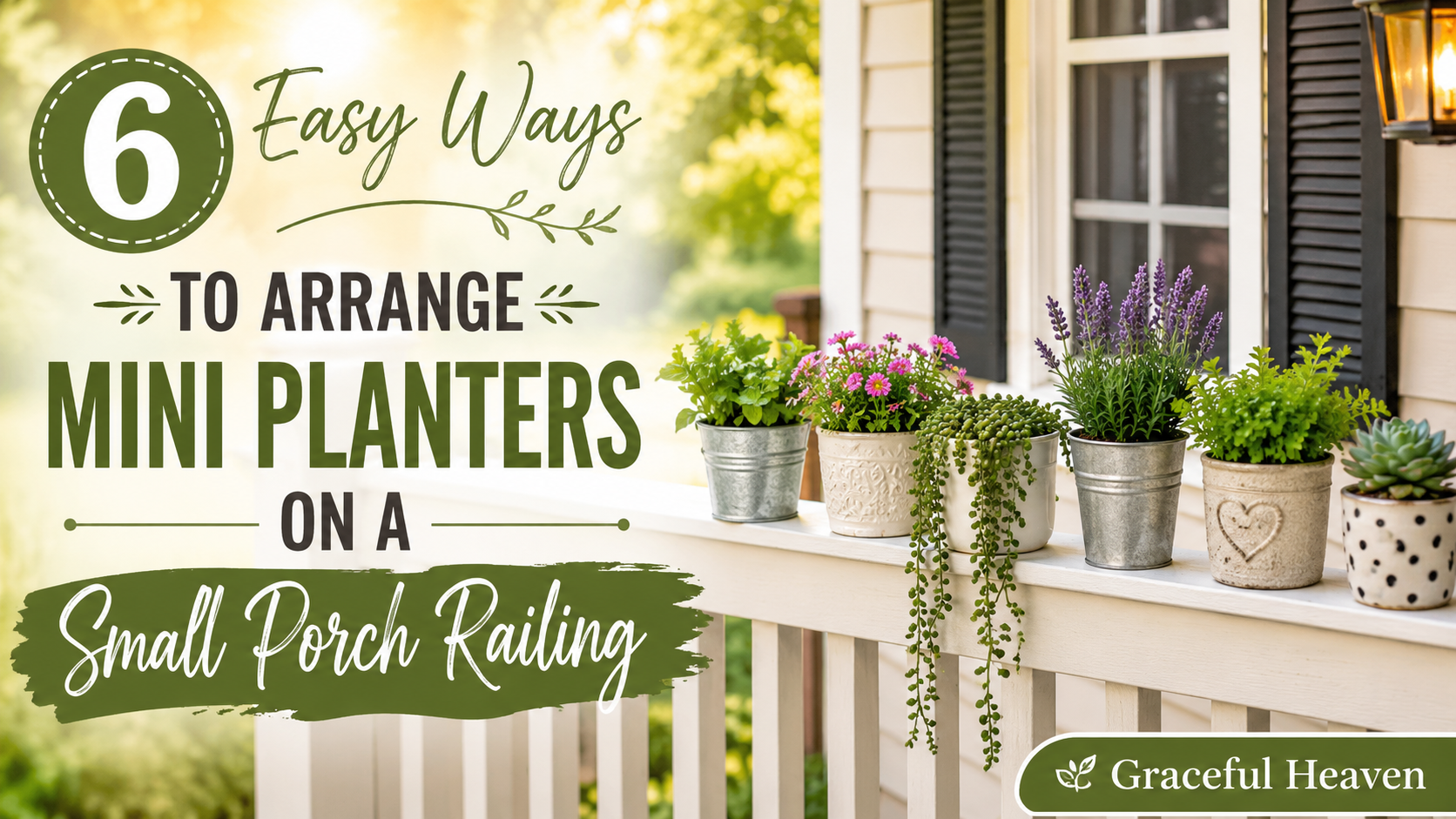
Your porch railing is basically wasted space right now. 😅
Think about it. That narrow strip of wood or metal running along your porch does nothing all day except hold your hand when you walk down the steps. Meanwhile, you’re squeezing pots onto a crowded floor, tripping over saucers, and wondering why your “cozy” porch feels more like an obstacle course. 🪴
Here’s the thing: a railing is prime real estate. It’s eye-level. It catches sunlight most floor plants never see. And when you arrange mini planters along it the right way, your whole porch suddenly looks like something out of a magazine — without the magazine budget. 📸
So let’s fix this. Below are six ways to actually use that railing, whether you’re working with two feet of space or twenty.
1. The Classic Clip-On Row 🧷
This is the easiest entry point, hands down.
Clip-on planters hook right over the top rail, no tools, no drilling, no drama. You just squeeze them on like a clothespin and you’re done. For renters or anyone nervous about damaging their railing, this is the safest bet.
Pick planters with adjustable clamps so they fit different rail widths. A lot of cheap ones only fit standard 2×4 rails, and if your porch has something thinner or oddly shaped, you’ll be stuck returning them. Measure first. Seriously.
Now, spacing matters more than people expect. Cramming pots shoulder to shoulder looks busy and, honestly, a little chaotic. Leave six to eight inches between each one. That gap lets each plant breathe visually, and it stops the whole row from turning into a green blur when you glance at it from the yard.
Quick scenario: Say you’ve got a 10-foot railing. Five clip-on pots spaced evenly, alternating trailing plants like ivy with upright ones like herbs, creates rhythm. Without variation, it just reads as a shelf of green blobs. 🌱
2. Hanging Baskets at Staggered Heights 🧺
Height is your secret weapon here.
Most people hang baskets at the exact same level, which is a shame because it flattens the whole display. Instead, alternate the chain lengths. One basket hangs low, brushing the top of the rail. The next hangs a bit higher. Then back down again.
This zigzag creates movement. Your eye travels up and down as it scans the porch, instead of sliding flatly across a straight line. It’s a tiny trick, but it changes the whole feel of the space.
A word of caution though. Heavier baskets need sturdy hooks rated for real weight, not the flimsy screw hooks that come in a bargain pack. A soaked basket of petunias can weigh 15 to 20 pounds. If your hook can’t handle that, you’ll find out the hard way — usually after a storm. ⛈️
Trailing plants work best in baskets because gravity does the styling for you. Sweet potato vine, lobelia, bacopa — they all cascade downward and soften the hard edge of the railing itself.
3. Built-In Rail Planter Boxes 📦
This one takes a little more effort, but it pays off.
Rail planter boxes sit directly on top of the railing, straddling it like a saddle. Some hook over the edge, others use brackets that screw in. Either way, you get a continuous strip of soil instead of separate little pots, which honestly gives a much more polished, “designer” look.
The upside? You can plant in bulk. A single 24-inch box might hold three or four small plants clustered together, which reads as fuller and more intentional than scattered individual pots.
The downside, and I’ll be straight with you: drainage gets tricky. Water runs off the bottom and onto your porch floor or, worse, onto whoever’s standing underneath. Look for boxes with a drip tray or elevated feet. Skip this step and you’ll regret it the first time you water in flip-flops. 💧
Mix textures inside the box rather than planting five of the same thing. Try a spiky plant like dracaena in the center, flanked by softer, rounder shapes like coleus or begonias on either side. That contrast is what separates a “nice” arrangement from one that actually stops people walking by.
4. Vertical Tiered Stands Anchored to the Rail 🪜
Small porches need to think vertically, not just horizontally.
A tiered stand — sometimes called a plant ladder — leans against or clips onto the railing and stacks two or three shelves upward. Suddenly you’ve tripled your planting surface without using any extra floor space. That’s huge if your porch is the size of a walk-in closet.
Put your tallest, sturdiest plants on top and cascading ones on the lower tiers. This isn’t random. It mimics how plants actually grow in nature, tall stuff reaching for light, low stuff spreading and trailing. Your brain reads it as “natural” even if you can’t quite explain why.
One tip that trips people up: don’t center the stand in the middle of the railing. Push it toward one end instead, near a corner or a support post. Centered stands can make a small porch feel cut in half. Off to the side, it becomes an accent instead of a wall. 🌸
5. Mixed-Height Pots Sitting Directly on a Wide Rail 🍯
Got a wide, flat-top railing? You’re lucky. Use it.
If your rail is at least 4 to 6 inches wide, you can skip clips and brackets entirely and just set sturdy little pots right on top. This works especially well with terracotta or concrete planters that have some heft to them, since wind won’t send them tumbling into the bushes.
Group them in odd numbers. Three, five, seven. Designers have leaned on this trick forever because odd-numbered groupings feel more natural to the eye than even ones. Nobody really knows why our brains prefer it, but they do.
Vary the pot heights too. A short, wide pot next to a tall, narrow one next to a medium one creates a little skyline effect along your railing. All the same height, and it just looks like a row of soldiers standing at attention. Not exactly charming.
For safety, especially if you live somewhere windy, use a bit of adhesive putty or a small rubber pad under each pot. It won’t be visible, but it’ll keep a gust of wind from knocking your favorite succulent onto the driveway. 🌬️
6. Alternating Color Blocks Instead of Random Placement 🎨
This last one isn’t about hardware. It’s about strategy.
Instead of grabbing whatever plants catch your eye at the garden center and placing them wherever, plan your color sequence before you buy anything. Alternating blocks of color, say, two pots of purple petunias, then two pots of white alyssum, repeated down the railing, creates a rhythm that random placement never achieves.
Think of it like a pattern in fabric. A solid color is boring. Total randomness is chaotic. But a repeating sequence? That’s what reads as “designed” even to someone who knows nothing about gardening.
You don’t need fancy or rare plants for this to work. Basic marigolds and basic geraniums, alternated in a clean pattern, will outperform a random mix of exotic plants every single time. Pattern beats variety when it comes to visual appeal on a small space. 🌼
A short paragraph here, because this point deserves its own room to breathe: consistency is what makes cheap plants look expensive.
Putting It All Together
You don’t have to pick just one of these. Actually, the best small-porch setups usually blend two or three approaches.
Maybe you clip on a row of herbs near your front door for easy snipping while you cook. Then a tiered stand in the corner for height. Then a couple of wide pots sitting directly on the rail near your seating area, color-blocked in purples and whites.
That layered approach is what makes a porch feel finished rather than thrown together. It’s the difference between a porch that looks like an afterthought and one that looks like someone actually lives there and loves it. 🏡
A Few Things Nobody Tells You
Sun exposure changes throughout the day, even on a small porch. What’s shaded at 9am might be blasting with light by 2pm. Watch your railing for a full day before committing to plant choices, or you’ll end up with sun-lovers wilting in shade and shade-lovers crisping in direct light.
Weight limits matter more than most people think. A standard vinyl or wood railing can typically handle clip-on planters just fine, but stacking multiple heavy pots directly on an aging or weathered rail is asking for trouble. If your railing wobbles when you lean on it, fix that before you load it up with soil and water. 🔧
Watering routine needs adjusting too. Railing planters dry out faster than ground pots because they’re exposed to more wind and airflow on all sides. What worked for your backyard garden bed won’t work here. Check moisture daily during hot stretches, not just when you remember.
Plants That Actually Thrive in Railing Conditions
Not every plant is cut out for railing life. Here’s what tends to do well:
- Petunias — tough, cascading, blooms all summer
- Sweet potato vine — fast-growing trailer, great for softening edges
- Herbs like thyme and oregano — low-maintenance, useful, smell great when brushed against 🌿
- Sedum — drought-tolerant, forgiving if you forget to water
- Lobelia — small but mighty, adds pops of blue and purple
- Dwarf marigolds — compact, cheerful, resist pests naturally
Avoid anything that needs deep, consistent moisture unless you’re committed to daily watering. Railing planters are shallow by nature, and shallow soil dries out fast. 🌡️
One Last Thing
Small porches get overlooked because people assume “small” means “limited.” It doesn’t. A railing gives you a built-in display shelf that ground-level gardens simply can’t match, and once you start seeing it that way, the whole space opens up.
Grab a few pots this weekend. Pick one method from this list. See how it changes the way your porch feels when you walk up to your own front door. 🚪🌻