That little table next to your accent chair is doing more work than you think. 🪑
Most people buy it, plop a lamp on top, and call it done. Then they walk past it every single day and feel like something’s off. They can’t name it. The room just feels… unfinished.
Here’s the thing. A small accent table isn’t just a landing spot for your coffee mug. It’s a chance to add personality, warmth, and a little visual rhythm to a corner of your home that usually gets ignored. 🌿
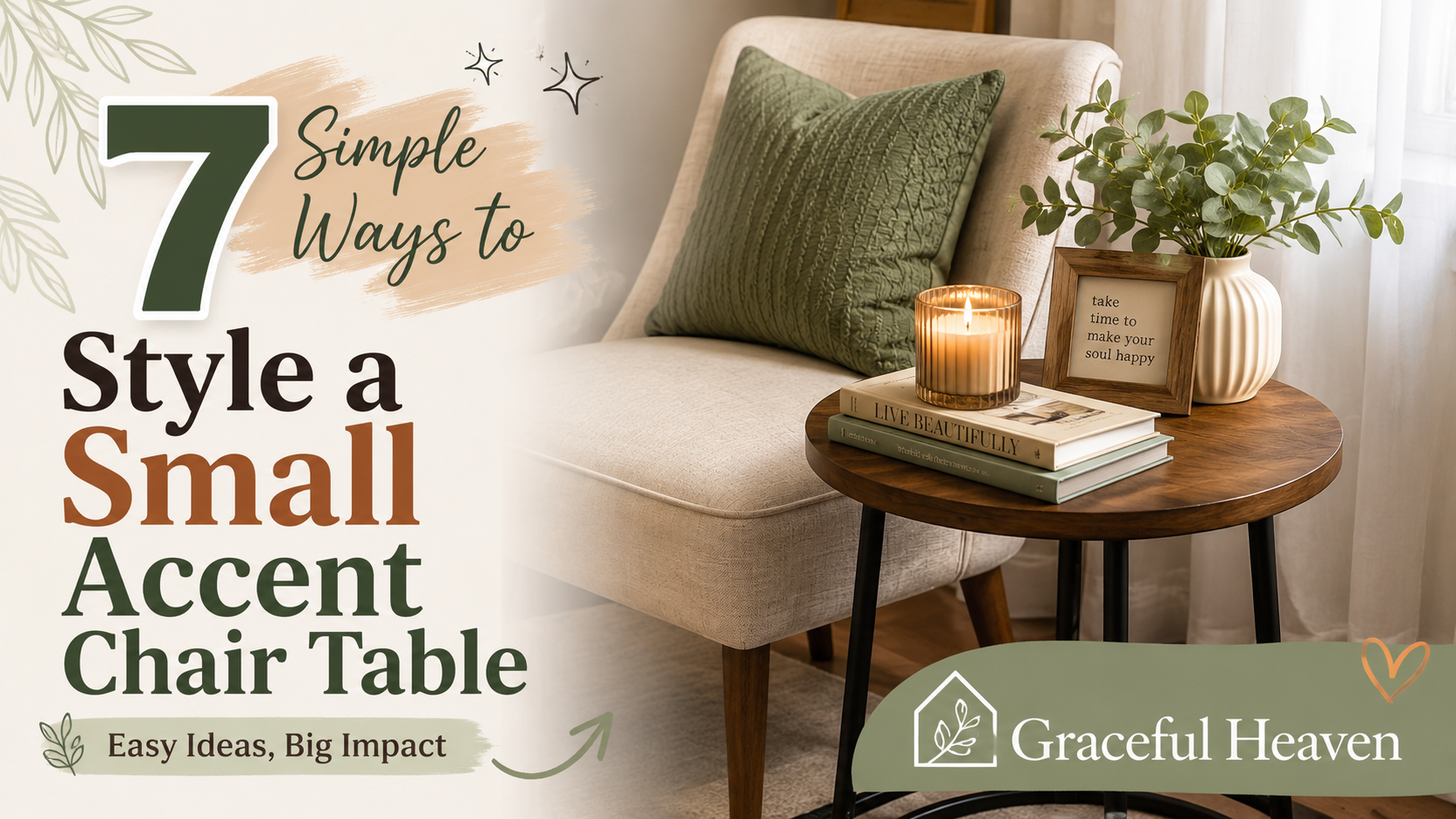
So let’s fix that. Below are seven ways to style it that actually work in real homes, not just in perfectly lit catalog photos.
1. Start With One “Hero” Object
Every good tabletop has a star.
Think of it like a movie cast. You need a lead actor, then supporting characters that don’t steal the spotlight. On a small table, that lead could be a sculptural vase, a stack of hardcover books with a great cover, or a small piece of art propped on a mini easel. 🎨
Pick something with a bit of height or visual weight. Then build around it.
A common mistake? Choosing three or four objects of the exact same size. Your eye doesn’t know where to land. It just bounces around, feeling scattered. Give it one clear focal point first, and everything else falls into place naturally.
Quick scenario: Say you’ve got a small round side table next to a reading chair. Instead of just a lamp, try a ceramic vase with one dried pampas grass stem as your hero. Add a lamp behind it, slightly smaller in visual presence, and a coaster in front. Done. That’s a styled table, not a cluttered one.
2. Respect the Rule of Odd Numbers 🔢
Odd numbers feel more natural to the human eye than even ones. Nobody fully knows why, but designers swear by it, and honestly, once you see it, you can’t unsee it.
Three objects instead of four. Five instead of six.
Even numbers tend to look like a matched set, almost like a display at a furniture showroom. Odd numbers feel collected. Curated. Like you actually live with these things instead of arranging them for a photo shoot.
Try this combo: one tall item (a vase or small lamp), one medium item (a stack of two books), one small item (a tiny dish for rings or coins). Three heights, three sizes, one cohesive little vignette.
Don’t overthink the math though. This is a guideline, not a law you’ll get arrested for breaking. If four objects look great to you, keep them. Trust your eye over any rule.
3. Layer With Books — But Do It on Purpose 📚
Books are the unsung heroes of small-space styling. They’re cheap, they add height variation, and they instantly make a table feel lived-in rather than staged.
But there’s a wrong way to do this.
Randomly stacking whatever paperback is nearby doesn’t work. It just looks messy. Instead, group two or three hardcovers by color or by spine texture. Neutral tones — cream, tan, deep green, navy — tend to blend beautifully into almost any room palette.
Stack them flat, then place a small object on top, like a mini plant or a smooth stone you picked up on a trip. That little touch turns “random pile of books” into “intentional design moment.”
One tip that surprises people: turn the spines toward the wall sometimes, showing just the page edges. It creates a softer, more textural look, especially if your books have busy or mismatched covers. Interior stylists do this constantly, and it works every time. ✨
4. Bring in Something Alive
A little greenery changes everything.
Seriously, nothing makes a table feel more human than a living plant, even a tiny one. 🌱 It doesn’t need to be elaborate. A small potted succulent, a single stem in a bud vase, or even a sprig of eucalyptus from the grocery store does the trick.
Plants add color that decor items usually can’t fake well. They soften hard edges too. If your table is glass or metal, a plant with some organic, irregular shape balances that coldness out beautifully.
No green thumb? No shame in that game. Faux plants have come a long way, and a realistic-looking artificial stem in a nice vase fools almost everyone. Just avoid anything too shiny or plastic-looking. Matte finishes read as far more convincing.
Here’s a small but important detail: keep the plant proportional. A giant fern on a tiny 14-inch table looks unbalanced and honestly a bit silly. Scale matters more than most people realize.
5. Think in Layers, Not Just Objects
This is where a lot of styling advice falls short. People talk about “what” to put on the table but skip the “how.”
So picture your table has three visual layers: a base layer (a tray or a piece of fabric), a middle layer (your main objects), and a top layer (something small resting on or leaning against another item).
A tray is honestly the secret weapon here. It groups smaller items together, so your table doesn’t look like a random collection of stuff. Everything on the tray reads as one unit. Off the tray, your remote or lamp reads as its own separate thing.
Try this setup: a small wooden tray holding a candle, a matchbox, and a tiny dish. Next to the tray, your lamp. Behind everything, one framed photo leaning against the wall. That’s three layers, working together, and it took maybe two minutes to arrange. ⏱️
6. Match the Table’s Personality to the Chair
Your accent table shouldn’t fight with your chair. It should complement it.
If your chair is bold — bright velvet, a loud pattern, something with real presence — let the table calm things down. Go neutral. Simple lines. Let the chair be the star of that corner.
But if your chair is more subtle, maybe a soft linen or a quiet neutral tone, the table can carry more visual interest. A textured surface, an interesting shape, maybe a brass or wood finish with some grain and character.
Think about it like a conversation between two people. One talks, the other listens. They take turns. Your chair and table should do the same thing visually, trading the spotlight instead of both shouting for attention at once. 🗣️
This also applies to color temperature. Warm wood chair? Lean into warm-toned decor on the table — brass, amber glass, cream ceramics. Cool-toned chair, maybe gray or blue? Try silver, glass, or cooler stone accents instead.
7. Rotate Your Styling With the Seasons
Nobody tells you this one enough.
Your table doesn’t need to look the same in July as it does in December. Small seasonal swaps keep a space feeling fresh without any real cost or effort.
Summer might mean a bowl of lemons or a single stem of something bright and citrusy. Fall could bring in a small pumpkin, some dried leaves, warmer tones like rust and mustard. Winter? Maybe a candle with a cozier scent, a chunky knit coaster, something that just feels warm to look at. ❄️🍂
You don’t need to buy new decor every season either. Rotate what you already own around the house. That vase from the dining table? Bring it over for a few weeks. Swap it back later. It costs nothing, and it keeps your eye from going numb to the same static arrangement year-round.
Small changes like this are honestly what separate a home that feels alive from one that feels frozen in place.
A Few Things to Avoid Along the Way
Quick gut-check before you start rearranging.
Don’t overcrowd it. A small table has small real estate. Three to five items, max, is usually the sweet spot. Anything more starts feeling cluttered fast.
Don’t ignore scale. A tiny table with an oversized lamp looks top-heavy and awkward. Match proportions to the size of the surface you’re working with.
Don’t forget function. Yes, styling matters. But if you actually use this table for your coffee, your book, your phone charger at night, leave room for that. A beautiful table nobody can use isn’t really doing its job.
Don’t copy a photo exactly. Pinterest boards and design blogs are great for inspiration, sure. But your home has different lighting, different colors, different needs. Use inspiration as a starting point, then adjust it to fit your actual life. 📸
Putting It All Together
So what does this look like in practice? Let’s walk through one full example.
You’ve got a small round accent table beside a linen-colored armchair. The chair is soft, quiet, neutral. So the table gets to have a bit more personality.
Start with a small woven tray as your base layer. On it, place a ceramic vase (your hero object) with two or three stems of something simple, maybe olive branches or dried wheat. Next to the vase, a short stack of two books in warm, neutral tones, with a small brass dish on top holding a couple of rings or a set of keys.
Off the tray, your lamp sits slightly behind everything, casting a soft glow in the evening. A single framed print leans against the wall behind the lamp, adding a bit of height and personality without needing a nail in the wall. 🖼️
That’s it. Five objects. Three layers. One hero piece. Odd numbers throughout. Warm tones matching the chair’s understated vibe. Nothing complicated, nothing expensive, and definitely nothing that took a design degree to figure out.
Your Table, Your Rules
At the end of the day, styling is personal. What works in someone else’s living room might feel completely wrong in yours, and that’s fine.
Use these seven ideas as a framework, not a checklist you have to follow perfectly. Swap things out. Break the odd-number rule if three objects looks lonely to you. Skip the plant if you know you’ll kill it within a week (we’ve all been there 😅).
The goal isn’t a perfect table. It’s a table that feels like your home, one small corner at a time.
Go grab something off a shelf somewhere else in your house right now, and see how it looks over there instead. You might surprise yourself. ✨