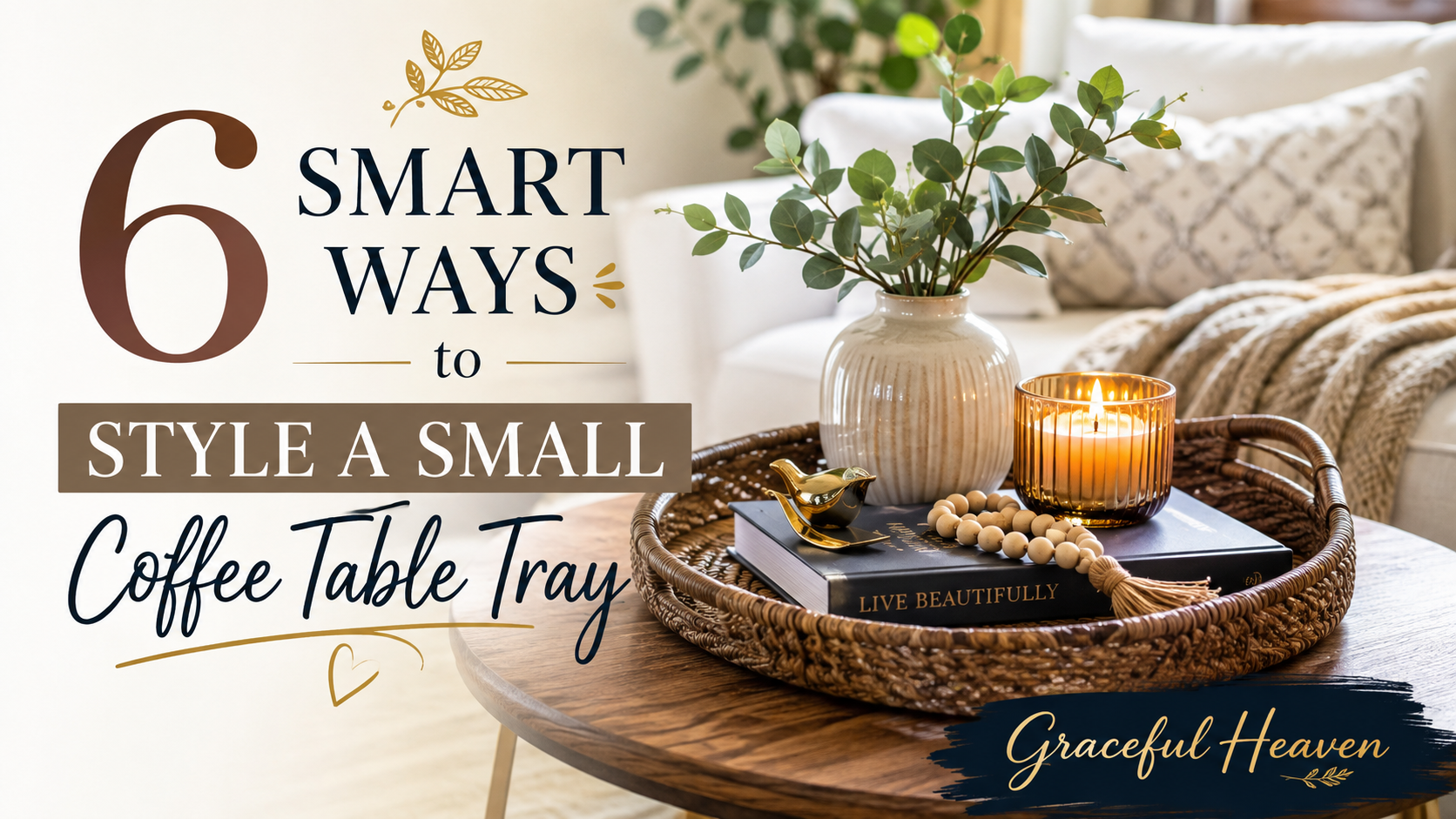
Your coffee table tray is doing more work than you think. 🛋️
It’s not just a place to dump your remote and a candle you forgot you owned. Done right, that little tray becomes the anchor of your whole living room. Done wrong, it just looks like clutter with a border around it.
Here’s the thing. Small trays are tricky. You don’t have the luxury of space that a big ottoman tray gives you. Every inch counts, and every object needs a reason to be there. So let’s talk about how to actually make that tiny rectangle (or circle, or oval, whatever you’ve got) pull its weight.
We’re going to walk through six approaches. Some are about color. Some are about height. One is about restraint, which sounds boring but is honestly the secret weapon most people skip. Grab your coffee ☕ and let’s get into it.
1. Build Around a Hero Object
Every good tray needs a star. Not a supporting cast of five equally-sized things fighting for attention, but one piece that your eye lands on first.
Think about a candle in a chunky ceramic vessel, or a small sculptural bowl with an interesting shape. That’s your hero. Everything else on the tray should feel like it’s orbiting around that one piece, not competing with it.
Here’s a quick scenario. Say you’ve got a vintage brass candle holder you picked up at a flea market. 🕯️ That’s your anchor. Now you add a stack of two books nearby, angled slightly, and maybe a tiny dish for rings or loose change. Three items. One clear focal point. Done.
The mistake people make is treating the tray like a shelf where everything gets equal billing. That’s not styling, that’s just storage. A hero object gives the whole arrangement a sense of hierarchy, and hierarchy is what makes a space feel curated instead of accidental.
If you’re not sure what your hero object should be, look around your house first. You probably already own something with a bit of personality — an odd little vase, a stone bookend, a small framed photo. Use what you have before buying something new. Trust me, it usually works better because it already fits your space.
2. Play With Height Variation 📏
Flat trays are boring. Not the tray itself, the arrangement on top of it.
If every object on your tray is roughly the same height, your eye has nowhere interesting to travel. It just skims across a flat line and moves on. You want peaks and valleys. A little visual rhythm.
A classic trick: stack two or three books, then place a small object on top of them, like a mini plant or a tiny sculpture. That gives you your tallest point. Then bring in a mid-height item, maybe a candle in a squat jar. Finish with something low and flat, like a small dish or a coaster stack.
Three levels. High, medium, low. It’s the same principle interior designers use for bookshelves and gallery walls, just shrunk down to fit a 12-inch tray.
You don’t need fancy risers or anything expensive. Books you already own work great, especially ones with interesting spine colors. A stack of two hardcovers can instantly become part of the design, not just something waiting to be read.
One thing to watch out for: don’t let your tallest object be so tall it feels top-heavy or unstable. Small trays wobble easily if things aren’t balanced. Keep your tallest piece under control, and make sure it’s not blocking the TV or a sightline across the room.
3. Stick to a Tight Color Story 🎨
This one trips people up more than any other tip on this list.
You don’t need five colors on a small tray. You barely need three. Pick two, maybe three tones, and let everything else follow that lead.
Think warm neutrals — cream, tan, a bit of brass. Or go moody with black, deep green, and a touch of gold. The specific palette matters less than the discipline of sticking to it. When every object matches loosely, even random items start to look intentional.
Here’s a mini experiment you can try right now. Look at your current tray setup. Count the distinct colors. If it’s more than three, that’s probably why it feels chaotic even though nothing on it is “wrong.”
So what do you do if you love color? Fair question. You can absolutely have one bold pop — a red vase, a bright yellow candle — but treat it like a spice, not the main ingredient. One punch of color against a neutral base reads as confident. Five competing colors reads as leftover clutter from five different shopping trips.
Texture counts here too. A matte black tray with a glossy ceramic dish and a woven coaster gives you variety without needing extra colors to do it. Mixing finishes — matte, glossy, woven, metallic — adds richness even when your palette stays simple. 🤎
4. Use the “Rule of Odd Numbers” (But Break It On Purpose Sometimes)
Odd numbers of objects feel more natural to the eye than even ones. This isn’t some made-up design myth, it genuinely holds up. Three items feel balanced. Two often feels like a pair standing awkwardly at a party, not quite sure what to say to each other.
So aim for three or five objects on your small tray. Not more. Small trays get overwhelmed fast, and once you cross five items, you’re back in clutter territory no matter how nice each individual piece is.
But — and this is where a lot of “design rules” articles stop short — sometimes two objects work beautifully. A single tall vase next to a single low candle can feel intentional and calm, almost minimalist. It’s about confidence, not blindly following a number.
The real rule underneath the rule is this: avoid symmetry that feels stiff. Two identical candles placed perfectly mirrored on either side of a tray looks like a hotel lobby, not a home. Vary the sizes. Vary the shapes. Let things feel a little imperfect, a little lived-in.
Try this the next time you’re arranging: place your items, then step back and squint at the tray from across the room. Does one side feel heavier? Adjust until it feels settled, not staged.
5. Let the Tray Match Its Table, Not Fight It
People obsess over what goes ON the tray and completely forget about the tray itself.
Your tray needs to feel like it belongs on that specific table. A sleek glass coffee table wants a tray with some texture — rattan, wood, or a matte finish — to soften all that hard shine. A rustic wood table, on the other hand, can handle a smoother, more polished tray without looking out of place. Contrast, used well, creates balance instead of clash.
Size matters more than people expect too. A tray that’s too small on a large table looks lost, like a single ice cube in a big glass. A tray that’s too big crowds everything else you might want on the table, like a remote or a coffee mug. As a rough guide, aim for your tray to take up somewhere around a third to half of your table’s surface. That leaves breathing room without looking sparse.
Shape is worth a thought as well. Round trays soften a room full of sharp angles — think square coffee tables, boxy sofas. Rectangular trays do the opposite, adding structure to a room that’s all curves and soft lines. It sounds like a small detail. It’s not.
And don’t forget function. If you actually use your coffee table daily — resting drinks, propping up a laptop, whatever — leave room around the tray, not just on it. Nobody wants to knock over a styled vignette just to set down a cup of tea. 🍵
6. Rotate It Seasonally (Or Just Whenever You’re Bored)
This last one isn’t really a styling technique. It’s more of a mindset shift.
Your tray doesn’t need to stay the same forever. In fact, it probably shouldn’t.
Swap in a small pumpkin or pinecones for fall. Bring in greenery and lighter colors come spring. In winter, a single pillar candle and some dried branches can completely change the mood of the whole room, and it takes maybe ten minutes to pull off.
You don’t need a big budget for this either. Half the fun is raiding your own house for stuff you forgot you had. A smooth rock from a beach trip. A small dish you never use for its “real” purpose. An old perfume bottle with a nice shape. Repurposing random objects as tray decor is basically free styling, and it keeps your space feeling fresh without buying a single new thing.
Here’s a small challenge for you: next time you’re feeling stuck creatively, or just bored of your living room, don’t buy anything new. Walk through your house for five minutes and pull three objects you like the look of. Put them on the tray. See what happens. Half the time, you’ll surprise yourself.
Seasonal rotation also keeps you from over-styling a “permanent” arrangement that starts collecting dust, literally and figuratively. A tray that changes with the seasons feels alive. A tray frozen in place since you moved in feels like it’s just… there.
Bringing It All Together
None of these six ideas work in isolation, not really. The hero object needs height variation to shine. Height variation needs a tight color story or it turns into visual noise. Odd numbers need a tray that actually fits the table underneath it.
Start small. Pick one tip from this list, the one that feels most doable today, and just try it on your current setup. You don’t need to overhaul your whole living room this afternoon.
So go grab that candle you love, clear off the tray, and give it five minutes. Your coffee table might just become the best-looking corner of the room. ✨