
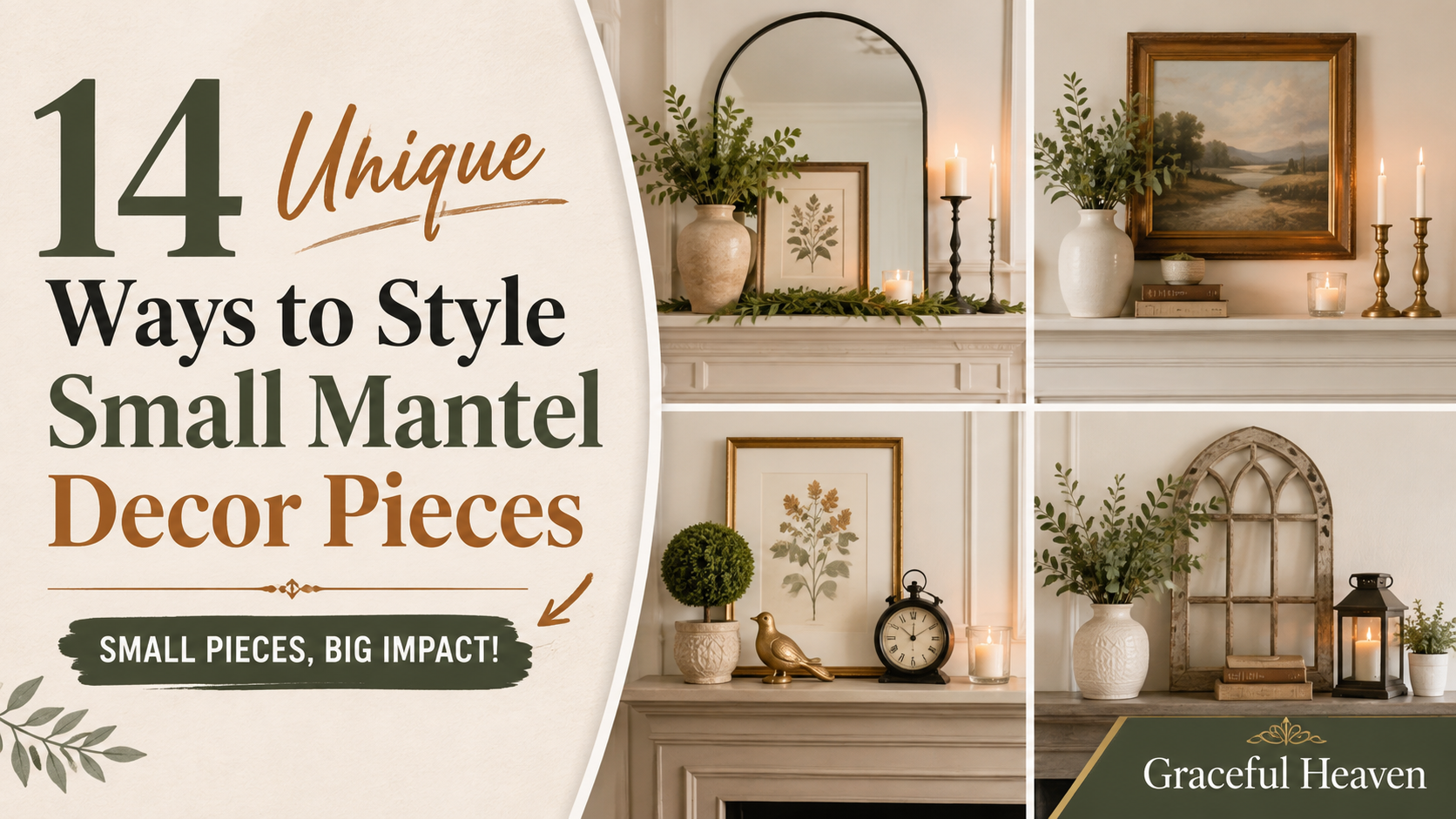
Your mantel is basically the face of your living room. 🏡 It’s the first thing people see when they walk in, and yet so many of us just… pile stuff on it and call it a day. A candle here, a photo frame there, maybe a vase your aunt gave you in 2019. Done.
But here’s the thing: small decor pieces are actually harder to style than big statement items. A giant mirror does the work for you. A tiny brass bell or a mini ceramic vase? That needs intention. It needs a plan.
So let’s talk about how to actually make those small pieces sing, instead of getting lost in the shuffle. 🎨
1. Group in Odd Numbers (Yes, It Actually Works)
Designers keep saying this for a reason. Groups of three, five, or seven just feel more natural to the eye than pairs. Nobody really knows why our brains prefer it, but they do.
Try this: grab three small objects of different heights — a candle, a little sculpture, a tiny framed print propped up — and cluster them together. Not lined up like soldiers. Slightly staggered, like they landed there naturally. ✨
Even numbers tend to feel stiff, almost corporate. Odd numbers feel collected, like you found these things over time instead of buying them all in one Target run.
2. Play With Height Like You’re Building a Skyline
Flat mantels are boring mantels. Period.
You want peaks and valleys. Think about a city skyline — some buildings are tall, some are squat, and that contrast is what makes it interesting to look at. Your mantel needs the same logic.
Use books as risers. Stack two or three under a small vase to lift it up. Then let a low, wide object like a dried flower bundle sit right next to it on the mantel surface itself. The eye moves up and down, and that movement keeps a small vignette from feeling flat or forgotten.
3. Anchor Everything With One Large Piece First
Small pieces need a big sibling. Without one, they just look scattered, like leftover confetti nobody swept up.
Start with your anchor — a mirror, a large piece of art, or even an oversized clock — and hang or lean it first. Only after that’s placed should you bring in the small stuff. This isn’t optional, honestly. It’s the difference between a styled mantel and a cluttered shelf. 🪞
Everything smaller than that piece should feel like it’s in conversation with it, not competing for attention.
4. Use Trays to Corral Tiny Objects
Here’s a trick that changes everything: put your smallest items on a small tray or a shallow dish.
Why does this work so well? Because tiny objects scattered directly on a mantel read as clutter. The same objects, contained on a tray, read as a curated little collection. It’s a weird psychological trick, but it’s true every single time.
A brass tray with a candle, a small dish of stones, and a mini bud vase looks intentional. The same three items just placed loose look like you forgot to put them away.
5. Lean, Don’t Always Hang
We default to hanging art above a mantel because that’s what we’ve always seen. But leaning breaks the rule in a good way.
Lean a medium frame against the wall, then layer a smaller frame in front of it, slightly off to one side. Add a tiny sculpture or bud vase in the gap between them. This layered-lean approach adds depth that a single hung piece just can’t give you.
It also means you can rearrange things in five minutes flat. No nail holes, no measuring, no drama.
6. Mix Textures Like You’re Cooking a Meal
Think about a good dish for a second. You don’t want everything soft, and you don’t want everything crunchy either. You want contrast — that’s what makes it interesting.
Mantels work the same way. Pair something smooth (a ceramic vase) with something rough (a chunky stone or a piece of raw wood). Add something metallic for shine, and something matte to calm it down. 🕯️
A small brass candlestick next to a linen-covered book next to a rough clay bowl? That’s texture doing real work. Skip this step, and even a well-arranged mantel can feel weirdly cold.
7. Let Negative Space Breathe
This one’s counterintuitive, but stick with me.
The temptation with small pieces is to fill every inch. Resist it. Empty space isn’t wasted space — it’s what makes the objects you do have actually pop.
Picture a busy mantel packed edge to edge versus one with three carefully placed items and generous gaps between them. The second one looks expensive. The first one looks like a garage sale. Same items, wildly different feeling, just because of how much air you leave around them.
8. Rotate Seasonally With a “Core Kit”
You don’t need to buy new decor every season. That gets expensive fast, and honestly, it’s not sustainable either.
Instead, build a small “core kit” — maybe three or four neutral pieces that stay on the mantel year-round. A ceramic vase. A stack of books. A simple sculptural object. Then swap in small seasonal accents around that core: a few dried branches in autumn, some greenery in December, a bowl of citrus in spring. 🍊
The bones stay the same. Only the accents change. It’s efficient, and it also means your mantel always has a “you” quality to it, no matter the season.
9. Use Color Blocking in Miniature
Small objects can vanish visually if they’re all competing colors with no logic behind them.
Try this instead: pick two or three colors max, and repeat them across your pieces. Maybe it’s cream, terracotta, and brass. Every item you place should nod to one of those three tones.
This doesn’t mean everything has to match perfectly — that would look sterile. It means there’s a thread connecting the pieces, so your eye reads them as a set instead of five random things that happened to end up in the same room.
10. Frame the Mantel With Bookends of Sorts
Here’s a layout trick borrowed straight from bookshelves. Place slightly taller or bolder items at each end of the mantel, then let things get smaller and quieter toward the middle, where your anchor piece usually lives.
It creates a natural frame. Your eye starts at one end, travels across, and lands somewhere in the middle without feeling lost.
Two matching candlesticks at either end, with smaller varied pieces filling in between? Classic for a reason. It’s basically the mantel version of matching earrings — a small detail that pulls the whole look together.
11. Add One “Weird” Object on Purpose
Every great mantel has one piece that doesn’t quite make sense — and that’s exactly why it works.
Maybe it’s a small vintage clock that doesn’t tell time anymore. Maybe it’s a tiny brass hand, or a strange little painted egg from a flea market. This object shouldn’t match anything. It shouldn’t try to.
Think about it — the mantels that feel truly personal, the ones you actually remember after leaving someone’s house, almost always have that one odd piece. It signals a real person lives here, not a showroom. 🦋
12. Layer Frames at Different Depths
Don’t just line up frames like a hallway of school photos. Stagger them front to back.
Put a small frame flat against the wall. Then, slightly in front and to the side, lean a second, smaller one at an angle. This creates visual depth even in a space that’s only a few inches deep, which is basically what a mantel top always is.
It’s a small move, but it turns a flat display into something that feels almost three-dimensional.
13. Use a Runner Instead of Nothing
Most people skip this completely, and honestly, it’s an easy win.
A thin table runner or a strip of fabric across the mantel gives your small objects something to sit on besides bare wood or stone. It also softens hard mantel materials, especially if you’ve got a stone or marble surface that can feel a little cold or clinical on its own.
Choose something simple — linen, a muted stripe, nothing too busy. The runner’s job is to support the objects on top, not steal the spotlight from them.
14. Step Back and Squint (Seriously)
This sounds silly, but professional stylists actually do this on every single project.
Walk about ten feet away from your mantel. Squint your eyes slightly. What jumps out? What disappears into the background? Squinting blurs the small details and reveals the overall shape and balance of your arrangement, which is honestly hard to judge from up close.
If one object vanishes completely when you squint, it’s probably too small or too similar in tone to what’s around it. If something jumps out too aggressively, it might need a quieter neighbor. This is the fastest, cheapest styling tool you’ll ever use, and it costs you exactly zero dollars. 👀
A Few Final Thoughts on Making It All Work Together
Styling a mantel isn’t a one-and-done task, and it was never supposed to be.
The best ones evolve. You’ll swap a candle for a vase, then swap that vase for something you found at a flea market six months later. That’s not indecision — that’s just how a lived-in home actually works.
Start small. Pick two or three of these fourteen tricks, not all of them at once. Try the odd-number grouping with the tray idea, maybe add one weird object for personality, and just live with it for a week. See how it feels every time you walk past.
Small pieces have a way of adding up to something that feels much bigger than the sum of its parts. 🕯️✨ Give your mantel some room to tell your story, one tiny object at a time.