Your living room feels off. You can’t quite name it.
The couch is fine. The lighting works. But your eyes keep landing on that flat, cluttered, or weirdly empty coffee table sitting dead center in the room — and something about it just isn’t clicking.
Here’s the thing: a coffee table isn’t just a surface for your remote and a half-empty water glass. It’s the anchor point of your whole living room. Guests look at it. You rest your feet on it. It’s basically the stage where your décor either performs or falls flat. 🎭
And no, you don’t need a $400 Anthropology bowl or a designer tray to fix it. You need a little intention, a small budget, and maybe twenty minutes on a Saturday afternoon.
So let’s talk about how to actually style a small coffee table without spending a fortune — or making it look like a Pinterest board threw up on your living room. 😅
Why Small Coffee Tables Are Actually Harder to Style
You’d think small equals easy. Less space, fewer decisions, right?
Wrong.
Small coffee tables are unforgiving. There’s no room for filler pieces or “I’ll figure it out later” clutter. Every object earns its spot, or it doesn’t belong there at all. A big table can absorb a messy stack of books and a candle you forgot to trim. A small one? It shows everything. Every mismatched color, every awkward gap, every item that’s just a little too big for the space.
Think about it like packing a small suitcase for a weekend trip. You can’t bring everything. You bring what works, what layers well, and what actually gets used.
Same logic applies here.
1. Start With a Tray (Seriously, Just Start Here) 🪴
If you take away one tip from this whole article, let it be this one.
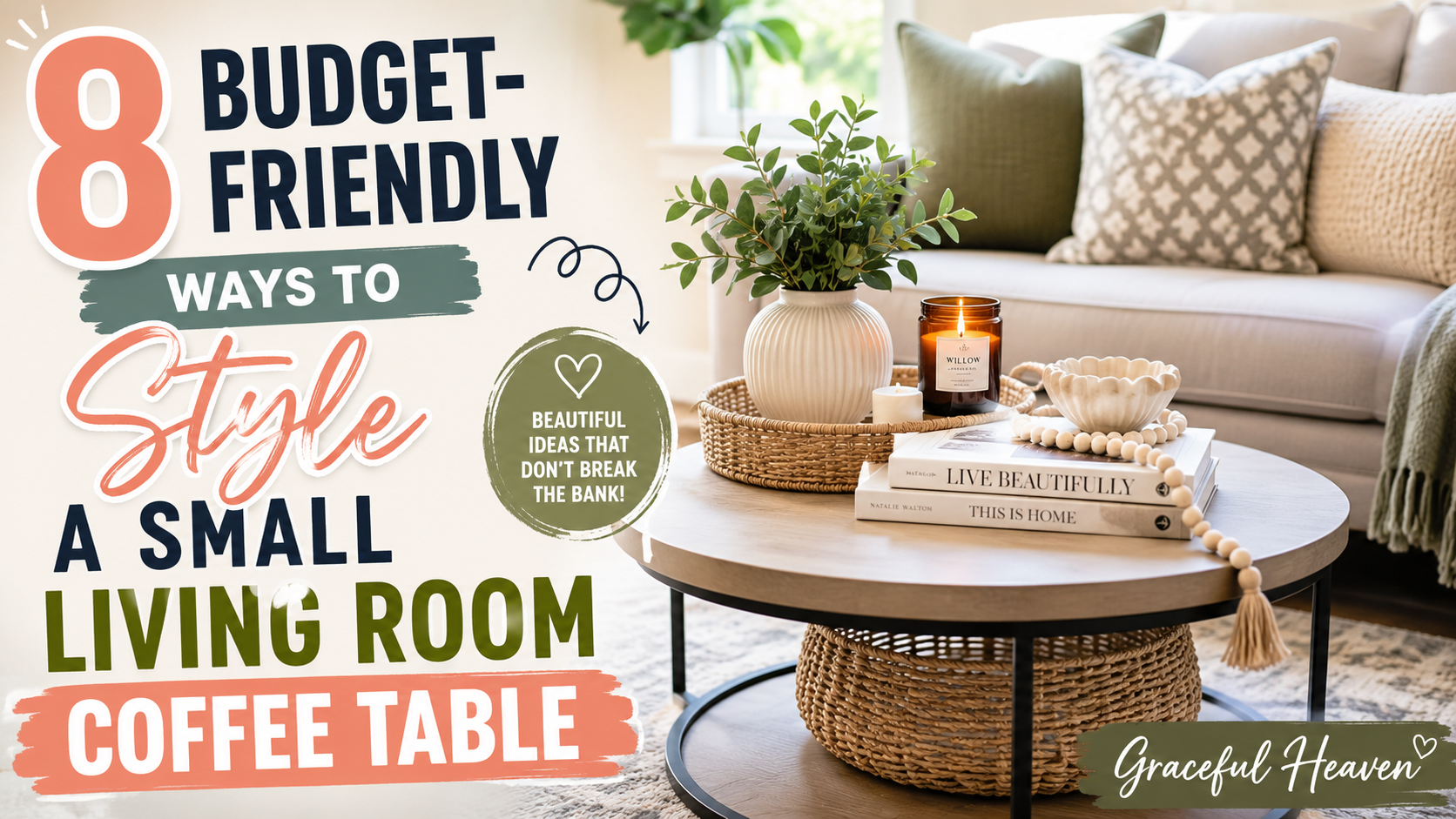
A tray does more heavy lifting than almost any other single object you can buy. It groups random items into one visual unit, so instead of looking cluttered, your table looks curated. Even three mismatched things — a candle, a coaster, a little dish — look intentional the second they’re sitting inside a tray.
You can find one at a thrift store for $3. A dollar store metal tray, painted matte black, looks shockingly expensive once it’s styled right.
Here’s a real scenario. Say you’ve got a remote control, some hand lotion, and a phone charger cluttering your table. Ugly, right? Toss them in a small woven tray, tucked to one side. Suddenly it reads as “organized minimalist” instead of “I gave up.”
That’s the power of containment.
2. Layer Height Like You’re Building a Tiny Skyline 🏙️
Flat surfaces are boring. Your eye has nothing to travel across.
The fix is height variation. Think of your table like a mini skyline — you want a tall piece, a medium piece, and something low and flat. This is called the rule of odd numbers in interior design, and it works because our brains find asymmetry more visually interesting than perfect symmetry.
A tall stack of two or three books. A medium-height candle or small vase sitting on top of that stack. A low, flat object — a small dish or a single stone — off to the side.
Don’t overthink the books, by the way. Thrift stores sell them by the pound sometimes. Pick ones with plain, neutral spines, or wrap a few in craft paper if the covers clash with your room.
3. Bring In Something Alive 🌿
A little greenery changes everything. It softens hard edges, adds real color, and honestly, it makes a room feel lived-in rather than staged.
You don’t need a fancy fiddle leaf fig for this. A small potted succulent from the grocery store checkout line costs about five bucks. Even a single stem of eucalyptus in a thrifted bud vase does the job.
Fake plants work too, if you’re not confident with real ones. Nobody’s judging. Just avoid the shiny, obviously-plastic kind — go for the ones with matte, textured leaves. They read as real from a few feet away, which is really all that matters here.
Plants are also just… calming. There’s something about a bit of green on your table that makes the whole room feel a little less sterile.
4. Steal the “Book, Object, Candle” Formula 📚🕯️
Professional stylists use variations of this trick constantly, and it works because it’s simple, repeatable, and cheap.
Grab one stack of books. Add one decorative object — a small bowl, a little sculpture, a rock you liked from a hike, whatever speaks to you. Add one candle.
That’s it. Three categories. Three textures. Done.
The magic is in the restraint. People tend to over-decorate small tables because they feel like emptiness equals unfinished. It doesn’t. A table with just those three elements, spaced with a little breathing room, looks more polished than one crammed with six knick-knacks fighting for attention.
5. Use Coasters as a Design Layer, Not Just a Function 🧊
Most people treat coasters as an afterthought — something you dig out of a drawer only when someone yells “use a coaster!”
Flip that thinking. A stack of two or three coasters, in a material that contrasts with your table, becomes a small styling element on its own. Wood coasters on a glass table. Marble-look coasters on a wood table. Even cork coasters, stacked slightly offset, add texture for basically no money.
Target and IKEA both sell sets under ten dollars. Thrift stores sometimes have vintage sets for even less, and honestly, vintage ones usually have more character than anything mass-produced today.
Leave them out. Stack them near your tray. Let them do double duty as both function and décor.
6. Don’t Ignore the Bottom Shelf 📖
Got a table with a lower shelf? Use it.
So many people leave that space empty, or worse, they dump random junk down there — old magazines, phone chargers, dust bunnies. That’s wasted styling real estate.
Roll up a soft throw blanket and tuck it there. It adds color, softness, and honestly makes the whole table feel cozier. Add a stack of larger coffee table books your top surface didn’t have room for. Or slide a woven basket underneath to hide remotes and coasters when you want a quick clean-up before guests arrive.
This is one of those small changes that people notice without knowing why. They just sense the room feels “finished.”
7. Play With Scent (Yes, Really) 🕯️
This one’s easy to overlook, but a coffee table isn’t just a visual object. It’s tactile. It’s sensory. People sit near it, lean over it, rest their arms on it.
A small candle or a bundle of dried lavender does something a throw pillow can’t — it changes how the space feels, not just how it looks. Dried flowers, in particular, are dirt cheap, last for months, and add a rustic texture that pairs well with almost any design style.
You can find dried eucalyptus bunches at most craft stores for under five dollars. Tie a bit of twine around the stems and lean them in a small vase. Done.
Little sensory touches like this are what separate a “styled” table from a table that just has stuff on it.
8. Rotate Seasonally (Because Static Décor Gets Boring) 🍂🌸
Here’s a tip nobody talks about enough: your coffee table shouldn’t look the same in July as it does in December.
Swap out a candle scent for the season. Change a vase’s flowers — even fake ones — from warm autumn tones to something brighter in spring. Add a small pumpkin in October. A tiny string of lights in December. A citrus-scented candle in summer.
This costs almost nothing if you plan ahead. Buy a few seasonal accents at end-of-season clearance sales, when everything’s marked down 70 percent, and store them in a shoebox for next year.
Rotating décor keeps your space feeling fresh. It also means you’re never staring at the exact same setup for eleven straight months, quietly getting sick of it without realizing why.
The Budget Breakdown (Because You’re Probably Wondering) 💰
Let’s get real about numbers for a second, since “budget-friendly” gets thrown around a lot without actual proof.
A thrifted tray: $3–8 A small potted plant: $4–10 Two or three coasters: $6–10 A candle: $5–12 Dried flowers or greenery: $4–8 A stack of secondhand books: free to $5
Add it up, and you’re looking at a full table refresh for somewhere between $20 and $45. Compare that to a single decorative bowl from a home goods store, which can run you $30 on its own, and suddenly this whole approach starts looking pretty smart.
A Few Mistakes to Skip 🚫
Overcrowding is the biggest one. If you can’t see the actual table surface anymore, you’ve gone too far. Pull back until there’s visible breathing room around each grouping.
Matching everything too perfectly is another trap. A table where every single item is the exact same shade of beige looks less like a design choice and more like you bought a “coffee table kit” off a website. Mix textures. Mix a little color. Let things feel collected, not curated to death.
And please, don’t forget function. A table so precious with decorative objects that you’re afraid to set down your coffee mug isn’t styled well — it’s just impractical. Leave a clear spot for actual use. That’s not a design flaw. That’s the whole point of the table.
Small Table, Big Impact
None of this requires a renovation, a design degree, or a trip to a fancy home store.
It just takes a little attention. A tray here. A plant there. A stack of books you actually meant to read someday. Small, cheap choices, layered together with a bit of intention, add up to something that looks — and feels — a whole lot more expensive than it actually was.
So go dig through that junk drawer, hit up a thrift store this weekend, or just rearrange what you already own. Your coffee table’s been waiting. 🛋️✨