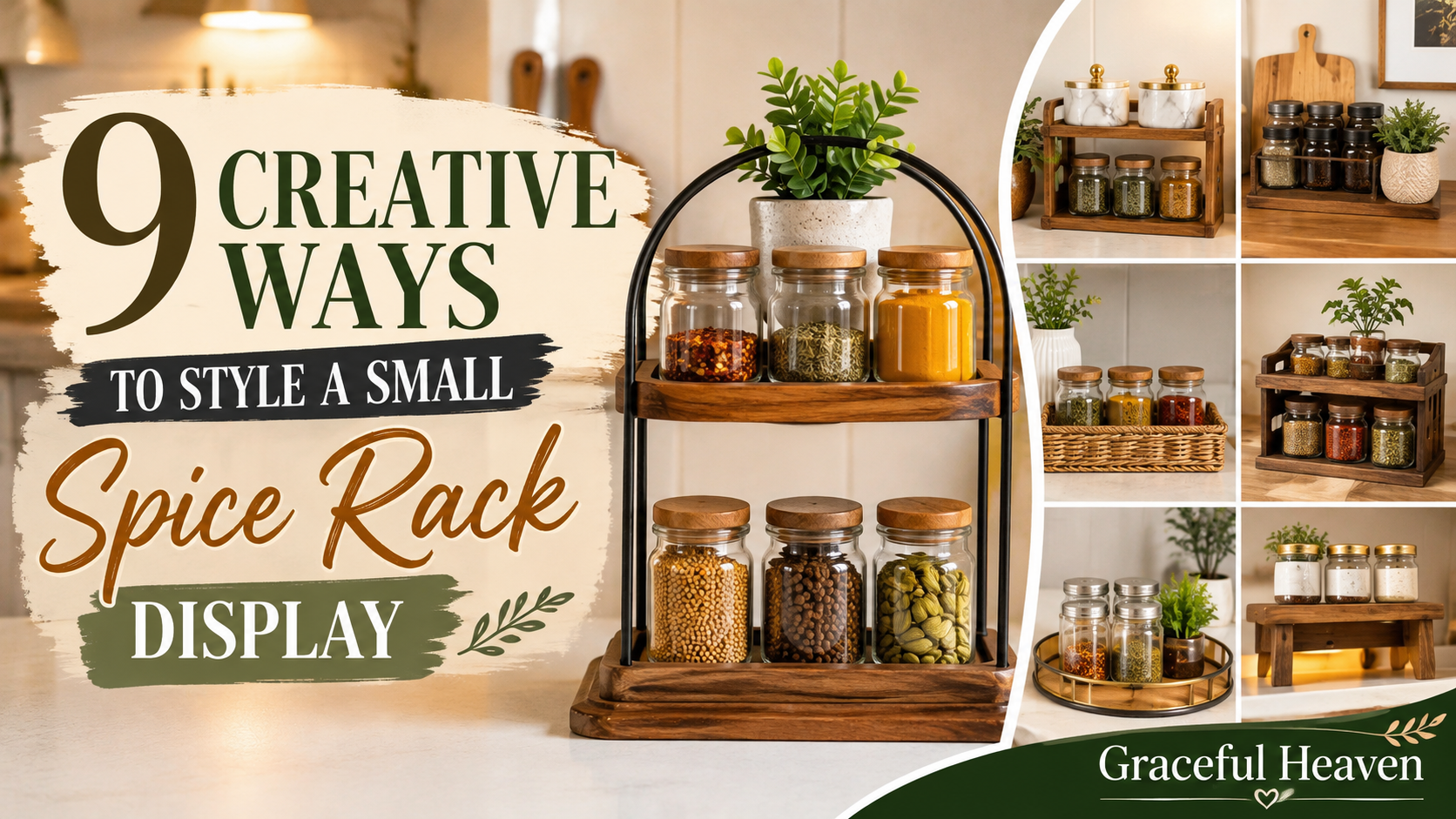
Your kitchen is tiny. Your spice collection is not. 🌶️
Sound familiar? Most of us end up with a drawer full of half-labeled jars, a shelf that’s one wobble away from disaster, or a cabinet where the cumin has been hiding behind the paprika since 2022. So let’s fix that. A small spice rack display isn’t just about storage. It’s about turning five square inches of wall or counter into something that actually looks good and works hard.
Here’s the thing: styling a spice rack is part function, part personality. You want to grab the cinnamon without knocking over three other jars. But you also want your kitchen to feel like yours. Below are nine ways to get both.
1. Go Vertical With a Tiered Wall Rack 📐
If your counter space is basically zero, look up. A tiered wall-mounted rack turns dead vertical space into prime real estate.
Think of it like a bookshelf, but for flavor. Three or four narrow shelves stacked above each other let you see every jar at eye level (or close to it), instead of digging through a drawer like you’re searching for buried treasure. Mount it beside the stove, and suddenly your most-used spices are an arm’s length away while you’re cooking.
Small footprint. Big payoff.
Pair it with matching glass jars, and you’ve got a display that looks intentional rather than accidental. Uneven mismatched containers on a tiered rack can look chaotic fast, so this is one spot where consistency really pays off.
2. Use a Magnetic Strip for a Floating Effect 🧲
Magnetic spice racks feel like a magic trick. The jars just… float there, stuck to a strip or the side of your fridge, with nothing but a thin magnetic base holding them in place.
This works especially well in apartments or rental kitchens where drilling holes isn’t an option. You stick the magnetic strip to the side of a cabinet or an unused patch of fridge, snap on the tins, and you’re done. No shelf, no bracket, no fuss.
A few practical notes though. Steel tins with strong magnets are worth the extra dollar or two, since flimsy ones tend to slide or tip when the fridge door swings open. And label the tops, not just the sides. You’ll be looking down at them most of the time.
The visual effect? Honestly striking. Rows of uniform tins clinging to a wall look like something out of a design magazine, minus the price tag of an actual renovation. 🧲✨
3. Repurpose a Vintage Tray or Cutting Board
Not everything needs a dedicated rack. Sometimes the best display is one you already own, just used differently.
An old wooden cutting board, propped against the backsplash, can hold four or five small jars lined up in a row. A vintage metal tray does the same thing but adds a bit of shine and texture. The trick is treating it like a mini stage. Group jars by height, tallest in the back, shortest up front, so nothing gets lost behind another bottle.
This approach costs nothing if you’re using items you already have lying around. And it adds a lived-in, collected-over-time feeling that a brand-new plastic rack just can’t fake.
Bonus: trays are portable. Cooking with friends over? Slide the whole thing to the table. Done cooking? Slide it back. That flexibility matters more than people expect in a small kitchen.
4. Build a Mini “Spice Library” With Labeled Jars 📚
Here’s a scenario. You open your spice drawer and see six jars, all identical, all facing the wrong way, all completely unlabeled on top. You have no idea which one is oregano until you unscrew three lids. Annoying, right?
A spice library fixes this by treating your collection like tiny books on a tiny shelf. Uniform glass jars, clear labels facing out, arranged either alphabetically or by how often you use them. Cumin, curry powder, and cinnamon might sit up front if you cook a lot of Indian food. Basil, oregano, and thyme up front if Italian is your thing.
Alphabetical order works for some people. Frequency order works better for most.
The label itself matters more than you’d think. Handwritten chalk labels feel warm and personal. Printed minimalist labels feel clean and modern. Either way, consistent fonts and jar shapes are what actually make this look like a “library” instead of a cluttered shelf.
5. Create a Rotating Carousel or Lazy Susan
Small spaces love a good rotating solution, and spice storage is no exception.
A lazy susan takes a corner cabinet or a tight countertop space and makes every jar accessible with a simple spin. No more reaching behind three bottles to grab the one in the back. You just turn the wheel until your target spins into view.
Picture cooking dinner with one hand stirring a pan and the other hand spinning the carousel to find smoked paprika. That’s the whole appeal. Speed and access, wrapped into one small rotating disk.
Two-tier carousels exist too, for people with bigger collections but still limited footprint. Bottom tier for everyday spices, top tier for the specialty stuff you use twice a year (looking at you, saffron).
6. Turn a Drawer Insert Into a Flat-Lay Display
Drawers get overlooked, but a shallow drawer near the stove can become one of the smartest spice displays in the whole kitchen.
Instead of jars standing upright and hidden under each other, a drawer insert holds them at a slight angle, labels facing up. You open the drawer and see everything at once. It’s basically a flat-lay photo, except it’s real and you’re cooking dinner instead of scrolling Pinterest.
This method takes zero wall space. Nothing sticks out. Nothing blocks a cabinet door. For a genuinely tiny kitchen, that matters a lot.
One tip: keep the insert shallow enough that you’re not stacking a second layer of jars on top of the first. Once you start double-stacking, the whole “see everything at a glance” benefit disappears.
7. Style an Open Shelf With Varying Jar Heights 🫙
Open shelving gets a bad reputation for looking messy. But with a little planning, it can be one of the prettiest ways to show off your spice collection.
The secret is height variation done on purpose. Instead of lining up ten identical jars in a row (which honestly reads a bit sterile), mix tall glass canisters with short stout ones. Add a small wooden bowl of loose bay leaves or dried chilies at one end. Tuck a tiny plant, like a rosemary sprig in a jar of water, at the other end.
You’re not just storing spices anymore. You’re building a little still-life scene that happens to be extremely useful.
Group by color if you want a bit of drama. Reds and oranges (paprika, chili flakes, cayenne) on one side. Greens and browns (oregano, thyme, cumin) on the other. It sounds like a small detail. It changes the whole feel of the shelf.
8. Use a Hanging Basket or Wire Rack for a Farmhouse Look 🧺
If your kitchen leans rustic, cottage, or farmhouse in style, a hanging wire basket brings that vibe straight into your spice storage.
Picture a shallow wire basket, the kind you’d expect to see holding fruit, mounted on a wall hook instead. Small burlap sachets, twine-tied jars, or simple glass bottles with cork stoppers sit inside it. The whole thing has texture. Rope, wood, wire, glass. It feels handmade even if you bought every piece online.
This works particularly well above a stove or on an empty wall strip beside a window. The natural materials catch light in a way that plastic containers just never will.
A small warning here: wire baskets aren’t the most airtight option, so this style suits dried herbs and whole spices better than finely ground ones that clump with moisture. Keep your fine powders somewhere sealed, and save the basket for bay leaves, dried chilies, cinnamon sticks, that kind of thing.
9. Design a Themed “Spice Station” by Cuisine
This one’s less about the rack itself and more about how you group what’s inside it.
Instead of organizing spices alphabetically or by size, organize them by the cuisine you cook most. A “taco night” cluster with cumin, chili powder, smoked paprika, and oregano. A “curry corner” with turmeric, coriander, garam masala, and cardamom. A “pasta shelf” with basil, oregano, red pepper flakes, and garlic powder.
Why does this matter? Because when you’re cooking, you’re not thinking “I need something starting with C.” You’re thinking “I’m making tacos tonight.” Grouping by cuisine matches how your brain actually works in the moment, not how a dictionary is organized.
Label each cluster with a small tag or a painted rock, whatever fits your style. Guests find it charming. You find it genuinely faster to cook with. Win-win. 🌮🍛🍝
A Few Extra Things Worth Knowing
Light and heat are the real enemies here, not clutter. Spices lose potency fast when they sit near a stove, an oven, or a sunny window. So even the prettiest display needs a little practicality baked in. If your favorite spot happens to be right above the burner, consider it a home for the spices you use up quickly, not the pricey saffron you bought for one recipe two years ago.
Refill your containers instead of buying new ones every time. Bulk bins at grocery stores or co-ops are cheaper, and they cut down on the eleven half-used bags shoved in the back of your pantry. Your display stays consistent, too, since you’re not introducing a random brand-new bottle shape every few weeks.
And don’t feel like you need to pick just one idea from this list. A magnetic strip near the stove for daily staples, paired with a small open shelf for the pretty stuff you don’t mind showing off? That combo works beautifully in a lot of kitchens. Mix and match until it fits how you actually cook, not how a magazine says you should.
Small kitchens force creativity. That’s honestly not a bad thing. Some of the best-looking spice displays come out of tight spaces, because tight spaces demand intention. Every jar earns its spot. Every shelf gets used.
So pick one idea, maybe two, and try it this weekend. Your future self, mid-recipe and reaching for the cumin, will thank you. 🌶️👩🍳