
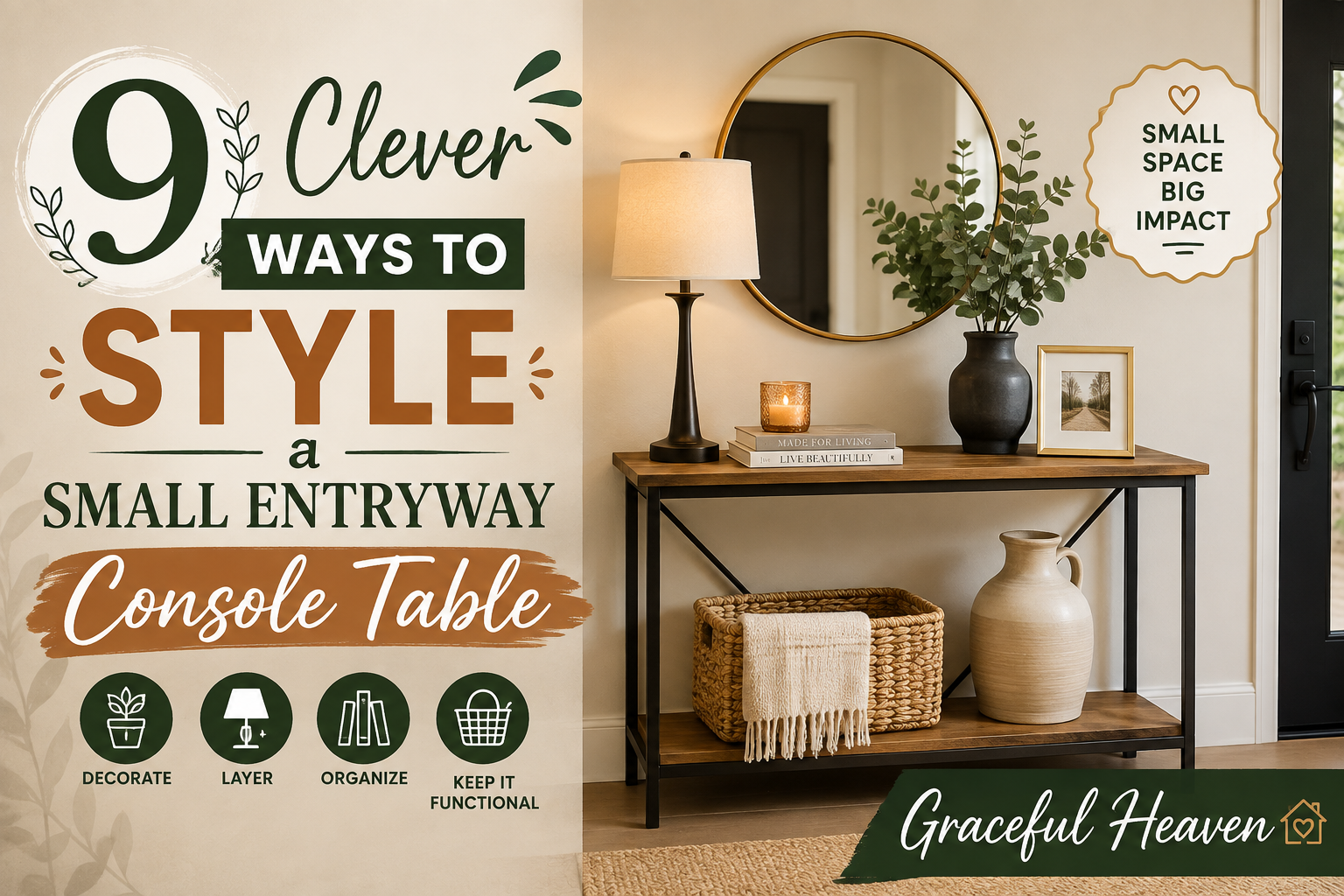
Walk into most homes and the entryway gets ignored. It’s the space people rush through, not the space they decorate. But that little strip of hallway, and whatever table sits against its wall, is the first thing your guests actually see. 👀
So why does it always end up looking like a dumping ground for mail, keys, and one lonely glove that lost its pair?
Here’s the thing. A small console table doesn’t need a big budget or a ton of square footage to feel intentional. It just needs a little strategy. Below are nine ways to turn that forgotten corner into something people actually notice when they walk in.
1. Anchor It With One Statement Piece 🏺
Every great console table has a hero. One object that draws the eye before anything else does.
Maybe it’s a tall ceramic vase with dramatic branches. Maybe it’s a sculptural lamp with an odd, interesting shape. Whatever you pick, give it room to breathe. Don’t crowd it with five other items competing for attention.
Think about a gallery. Museums don’t cram fifteen paintings onto one wall. They let the important piece stand alone, with space around it that makes it feel valuable. Your console table deserves the same respect.
A good rule: pick your statement piece first, then build everything else around it. Not the other way around.
2. Play With Height Like You’re Building a Skyline 🏙️
Flat surfaces look boring. Period.
If everything on your table sits at the same height, your eye has nowhere interesting to travel. You want peaks and valleys, the way a skyline has short buildings and tall ones mixed together.
Try this combo: a tall lamp on one side, a stack of two or three books in the middle, and a small dish or bowl on the other end. Suddenly you’ve got rhythm. Suddenly there’s a story happening across that surface instead of just… stuff sitting there.
Odd numbers help too. Three items of varying heights almost always look more natural than two or four. It’s a small trick, but it works nearly every time.
3. Let a Mirror Do Double Duty 🪞
Small entryways often feel cramped, and a mirror above your console table fixes two problems at once.
First, it makes the space feel bigger. Light bounces around, the hallway opens up visually, and suddenly that narrow strip doesn’t feel like a hallway at all. Second, it’s genuinely useful. Nobody wants to leave the house without checking their hair or straightening their collar.
Go for a mirror with some personality. A plain rectangle works, sure, but an arched frame or a rounded shape adds softness to what’s usually a very boxy, angular space. Brass frames warm things up. Black frames add contrast if your walls are light.
One tip: hang it slightly lower than you’d think. Around 5 to 8 inches above the table is usually the sweet spot, so it feels connected to the furniture below it rather than floating awkwardly on the wall.
4. Introduce Texture, Not Just Color 🧺
People obsess over color palettes and forget about texture completely.
A smooth ceramic vase next to a woven rattan tray next to a rough linen table runner creates depth you can practically feel with your eyes. Even in a neutral, all-white setup, mixing textures keeps things from looking flat or sterile.
Try a small woven basket underneath the table for extra storage. Add a chunky knit throw draped over one corner if your entryway connects to a mudroom. These little textural moments matter more than people realize.
Glossy and matte together also creates nice tension. A glossy black lamp base paired with a matte stone bowl? That contrast catches the eye without you even knowing why.
5. Keep a Tray for the Chaos 🔑
Let’s be honest. Entryways collect chaos. Keys, sunglasses, that one receipt you meant to file three weeks ago.
Instead of fighting this reality, work with it. A decorative tray gives all that daily clutter a designated home, and it instantly looks more organized than loose items scattered everywhere. Brass trays feel elegant. Wooden ones feel warm and casual. Marble trays add a little weight and luxury without costing a fortune.
This isn’t just about looks either. When your keys have a spot, you stop losing them. When your mail has a spot, it stops piling into an avalanche. Function and style, working together.
6. Bring in Something Alive 🌿
A console table without any greenery just feels a little sad. There, I said it.
Plants add color that nothing artificial can fully copy, and they soften up a space that’s otherwise full of hard surfaces like wood, glass, and metal. If you don’t trust yourself with a real plant (no judgment, we’ve all killed a succulent or two), a high-quality faux plant works fine too.
Consider scale here. A tiny 4-inch pot might get lost next to a tall lamp. A trailing pothos or a small olive tree, on the other hand, adds presence without overwhelming a narrow surface. Even a single stem in a slim glass vase does the trick if space is really tight.
Small detail, big impact. That’s basically the theme of this whole list.
7. Layer In Personal Photos or Art 🖼️
A console table that only has decor items, no personal touches, ends up feeling like a hotel lobby. Nice, but cold.
Lean a small framed photo against the wall instead of hanging it. This creates a relaxed, collected-over-time look that feels far less staged than a perfectly centered gallery wall. Mix in a small piece of art, maybe something you picked up traveling, or a print that just makes you happy.
Rotate these pieces seasonally if you want. Swap in warmer tones for fall, brighter colors for spring. It keeps the space feeling current instead of frozen in whatever mood you were in the day you decorated it.
Your entryway should feel like your home. Not a showroom.
8. Respect the Rule of Negative Space ⬜
This one trips people up constantly. More stuff does not equal more style.
Negative space, meaning the empty areas you deliberately leave alone, is what makes everything else on the table actually pop. If every inch is covered in decor, nothing stands out because your eye can’t rest anywhere.
A useful trick: fill roughly 60 to 70 percent of the surface, and leave the rest open. That empty space isn’t wasted. It’s doing work, framing your objects and giving the whole arrangement breathing room.
Imagine a crowded party where everyone talks at once versus a smaller gathering where each person actually gets heard. Your console table items need that same kind of space to be noticed.
9. Match the Scale to the Space, Not the Trend 📏
Here’s a mistake people make constantly. They see a gorgeous console table styled in a huge foyer online, then try to copy it exactly in a narrow hallway that’s barely two feet wide.
It doesn’t translate. What looks proportional in a grand entryway can look cluttered and clumsy in a small one.
So measure first. A table under 12 inches deep needs slimmer accessories, smaller lamps, thinner trays. Oversized items will make the whole setup look like it’s about to tip over, even if nothing’s actually unstable.
Scale down your decor pieces to match your actual square footage, not the square footage of some influencer’s mansion. Your entryway will thank you, and honestly, it’ll look far more put-together because of it.
Small entryways get overlooked all the time, but they don’t have to stay that way. Pick two or three ideas from this list, start there, and see how the space feels after a week. You can always add more later. Sometimes the smallest corner of a home ends up saying the most about the people who live in it. ✨