
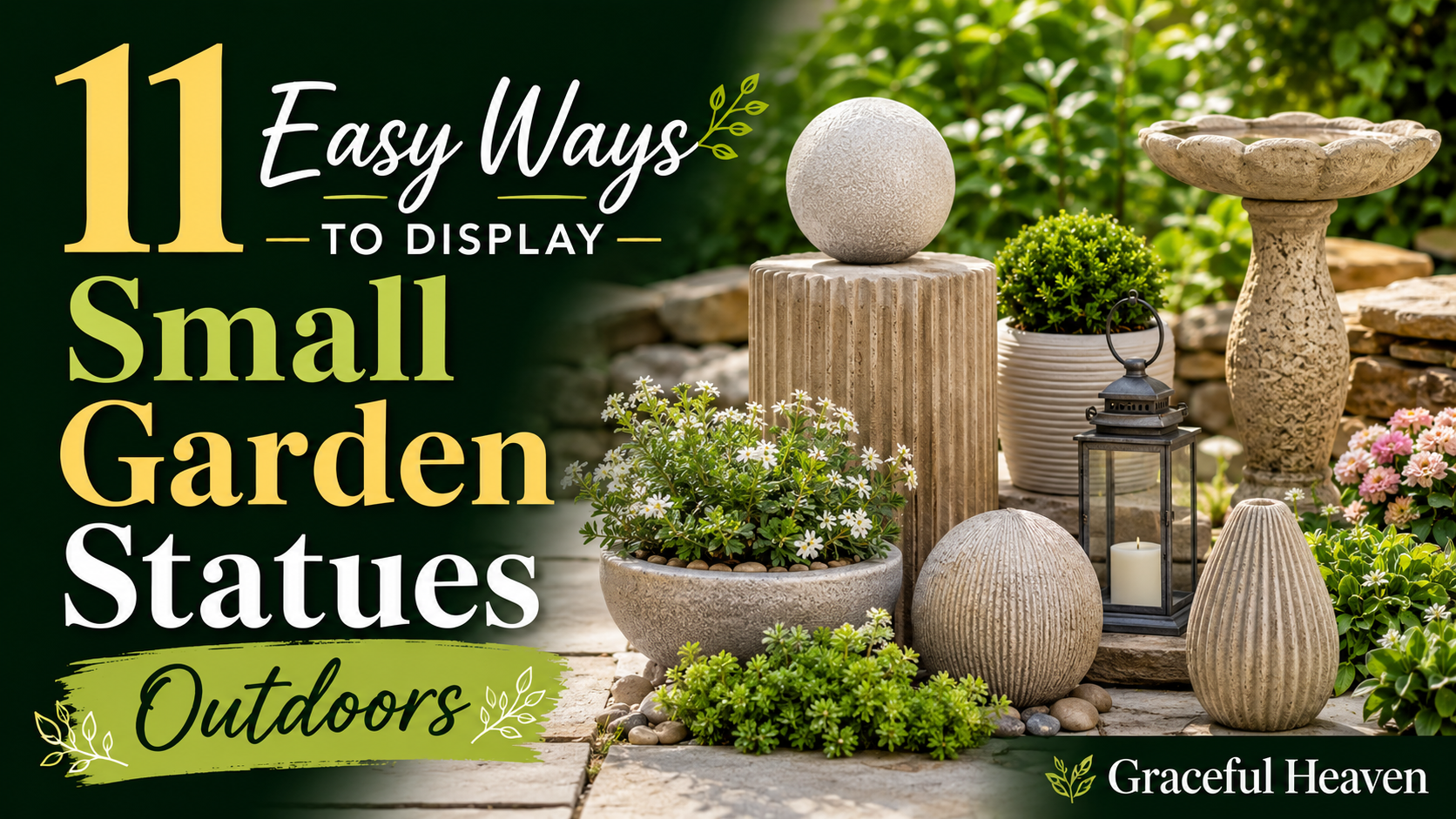
You bought a little stone rabbit. Or maybe a mossy gnome, a ceramic frog, or one of those small Buddha figures that just looked right the second you saw it. 🐸
And now it’s sitting on your porch step. Just… sitting there. Kind of lonely. Kind of lost.
Here’s the thing about small garden statues: they’re not decorations you can just plop down anywhere and forget about. Size actually matters more with small pieces than big ones. A six-foot fountain can hold its own in the middle of a lawn. A ten-inch fox statue? It needs help. It needs a stage, a frame, a little bit of drama.
So let’s fix that. Below are eleven ways to actually display your small garden statues instead of just storing them outside. Some of these take five minutes. A couple take a weekend. All of them work.
1. Tuck It Into a Flower Bed at “Peek-a-Boo” Height 🌸
This is the classic move, and it works because it plays with expectation.
You don’t want the statue front and center, staring at everyone who walks by. You want it half-hidden. Nestle a small rabbit or hedgehog statue about two-thirds of the way back in a flower bed, surrounded by low ground cover like creeping thyme or sweet alyssum.
The goal is discovery, not display. Someone walking past should catch a glimpse of an ear or a wing poking through the leaves and think, “Wait, was that there before?” That little double-take is the whole point. It’s the same reason kids love hide-and-seek — the surprise is more satisfying than the obvious.
Quick tip: plant something that grows around the statue’s base but stays lower than its head. Otherwise you’ll lose it completely by midsummer, and trust me, that happens more than you’d think.
2. Build a Mini Pedestal Out of Stacked Stones
Elevation changes everything.
A statue sitting flat on dirt reads as clutter. The same statue lifted eight inches off the ground on a stack of flat stones reads as art. It’s a strange psychological trick, but it’s real — height signals importance.
You don’t need a fancy pedestal from a garden center (though those exist and look great too). Three or four flat fieldstones, stacked and slightly staggered, do the job. Look for stones with a natural, weathered texture — they’ll blend into the landscape instead of fighting with it.
If you’re using something delicate, like a resin or lightweight cast piece, add a dab of construction adhesive between the top stone and the statue’s base. Wind and curious cats have ended more than one garden gnome’s career. 😅
3. Anchor It at the Base of a Tree
Trees give small statues something big trees are naturally good at giving anything: shelter, shade, and scale.
Place your statue right at the base of a mature tree, nestled between two root flares if the tree has them. This spot has a natural frame already built in — the trunk rises up behind the statue like a backdrop, and the canopy above provides dappled light that makes stone, resin, or ceramic textures pop.
Owls and woodland creature statues especially love this spot. There’s something about a small owl statue tucked against oak bark that just makes sense. It looks like it belongs there, not like someone placed it there.
One caution: avoid deep planting near roots you might damage, and skip this spot if the tree drops a lot of sap or berries that could stain the statue over time.
4. Create a Tiny “Statue Garden” Vignette
Why settle for one statue when a small grouping tells an actual story?
Group two or three small pieces together — say, a frog, a small toadstool ornament, and a miniature lantern — within a two-foot radius. Vary their heights. Vary their orientation. Have one facing slightly toward the others, like they’re mid-conversation.
This is where a lot of people get stuck, honestly, because grouping feels like it should be complicated. It isn’t. Think of it like arranging picture frames on a wall: odd numbers work better than even ones, and no two pieces should be exactly the same height. Three items of different sizes will almost always look more intentional than two items of similar size.
Add a thin layer of pea gravel or moss underneath the whole grouping to visually separate it from the surrounding lawn or mulch. That border does more work than people expect — it tells the eye “this is a scene,” not just random objects that landed there.
5. Set One Inside a Birdbath or Empty Planter
Got an old birdbath that birds never actually use? Or a big terracotta pot that’s just sitting there empty because you never got around to planting it?
Repurpose it. A small statue placed inside a shallow birdbath, especially a fairy, frog, or turtle figure, looks like it’s part of the water feature even when there’s no water in it. And if there is water, even better — statues partially submerged or peeking over the rim of a birdbath create a genuinely charming little scene.
Empty planters work the same way. Drop a few inches of soil or gravel into the bottom, set the statue in, and surround it with a low trailing plant like lobelia or bacopa spilling over the edges. Suddenly that pot you felt guilty about isn’t empty anymore. It’s a feature. 🪴
6. Use Solar Lights to Frame It at Night
Most people display their garden statues for daytime eyes only. That’s half the opportunity, gone.
A small solar spotlight, staked into the ground a foot or two in front of a statue, angled upward, changes the whole mood after sunset. Shadows stretch. Textures deepen. A plain stone rabbit becomes something almost cinematic once the sun goes down.
You don’t need to spend much here. Basic solar stake lights run cheap, and two of them, placed at slightly different angles, create more depth than one straight-on beam. Warm white light (not the harsh blue-white kind) tends to flatter stone and resin finishes best.
Bonus: this trick also helps you find your statues after dark, which matters more than you’d think if you’ve ever nearly tripped over a garden gnome at 10 p.m.
7. Perch It on a Low Garden Wall or Border Edge
If your yard has any kind of low retaining wall, brick border, or stacked-stone edge, you already have a built-in display shelf. Use it.
Small statues placed along the top of a border wall, spaced a few feet apart, create rhythm along a path or bed edge. This works especially well with matched sets — think a pair of small owls, or a trio of songbirds — spaced unevenly so the eye keeps moving.
Keep this spot for statues under a certain weight and size, though. Anything too heavy risks toppling the wall itself if it’s not mortared, and anything too tall will look precarious rather than intentional.
8. Nestle It Among Rocks in a Dry Creek Bed
If you’ve got a dry creek bed, a rock garden, or even just a cluster of decorative boulders somewhere in your landscaping, small statues fit right in.
Turtles, frogs, and lizard statues are the obvious choice here — they mimic what you’d actually find near real rocks and water, so the placement feels natural instead of staged. But don’t limit yourself. A small fox or rabbit tucked between two boulders, as if it just stopped to rest, reads as charming rather than random.
The trick is scale matching. A statue that’s too small gets visually swallowed by large rocks. A statue that’s too big looks like it doesn’t belong. Hold the piece up to the space before you commit — you’ll know pretty quickly if the proportions feel off.
9. Hang a Small Piece from a Shepherd’s Hook
Not every statue needs to sit on the ground. Some are actually designed — or can be adapted — to hang.
Small fairies, angels, wind spinners with figural details, or lightweight resin birds work beautifully suspended from a shepherd’s hook staked into a flower bed. The movement adds something ground-level displays can’t: motion. A gentle swing in the breeze catches the eye in a way a static statue never will.
If your piece wasn’t made to hang, you can often add a small eye hook and fishing wire or thin garden twine, as long as the material can handle a drilled hole. Skip this for anything solid stone or concrete — that’s a job for the ground, not the air.
10. Set It as a Focal Point at a Path Bend
Every garden path needs a moment. A pause. Something that makes you stop walking for two seconds.
Place a small statue right at a bend in a garden path, positioned so it’s the first thing visible as someone rounds the corner. This is one of the oldest tricks in landscape design, actually — professional garden designers call it a “terminal view,” and it works on a ten-foot path just as well as it works on a hundred-foot one.
You don’t need much space for this. Even a curved stepping-stone path in a small backyard has at least one bend where a statue can act as a little reward for continuing forward. 🌿
11. Display It on a Repurposed Plant Stand
Old plant stands — the wrought iron kind, or wooden ones with a bit of character — make surprisingly good statue pedestals, especially for pieces with more detail that deserve to be seen at eye level instead of down at your feet.
Set a small statue on top instead of a potted plant, and place the stand somewhere it’ll get noticed: near a doorway, at the entrance to a garden bed, or on a patio corner. The added height does the same thing stacked stones do (see #2), but with more visual polish, especially for statues with fine detail like feathers, fur texture, or facial expressions that get lost when they’re low to the ground.
If the stand is metal and starts rusting over time, don’t rush to replace it. A little rust patina actually complements stone and weathered resin statues rather nicely. It’s one of those rare cases where “letting it age” is the better design choice.
A Few Things to Keep in Mind Before You Start
Placement matters more than the statue itself, honestly. A beautiful piece in the wrong spot disappears. A modest piece in the right spot becomes a conversation starter.
A few practical notes worth tucking away:
- Check the material first. Concrete and stone tolerate freeze-thaw cycles fine. Resin and ceramic pieces are more fragile and may need to come indoors for harsh winters. 🥶
- Think about sightlines from inside your house, too. Some of the best statue placements are the ones you see from your kitchen window every morning, not just the ones visible from the street.
- Don’t overcrowd one area. Two or three well-placed statues across a yard beat six statues clustered in one flower bed every time. Spread the surprises out.
- Reposition seasonally if you want. There’s no rule that says a statue has to stay in one spot forever. Moving a piece to a spring bed, then to a shadier summer spot, keeps your garden feeling fresh without buying anything new.
At the end of the day, a small garden statue is really just an invitation. An invitation to slow down, look closer, and notice something you might’ve walked right past otherwise.
So go outside this weekend. Look at your yard with fresh eyes. Find that lonely statue on your porch step, and give it a real home. 🦉✨