
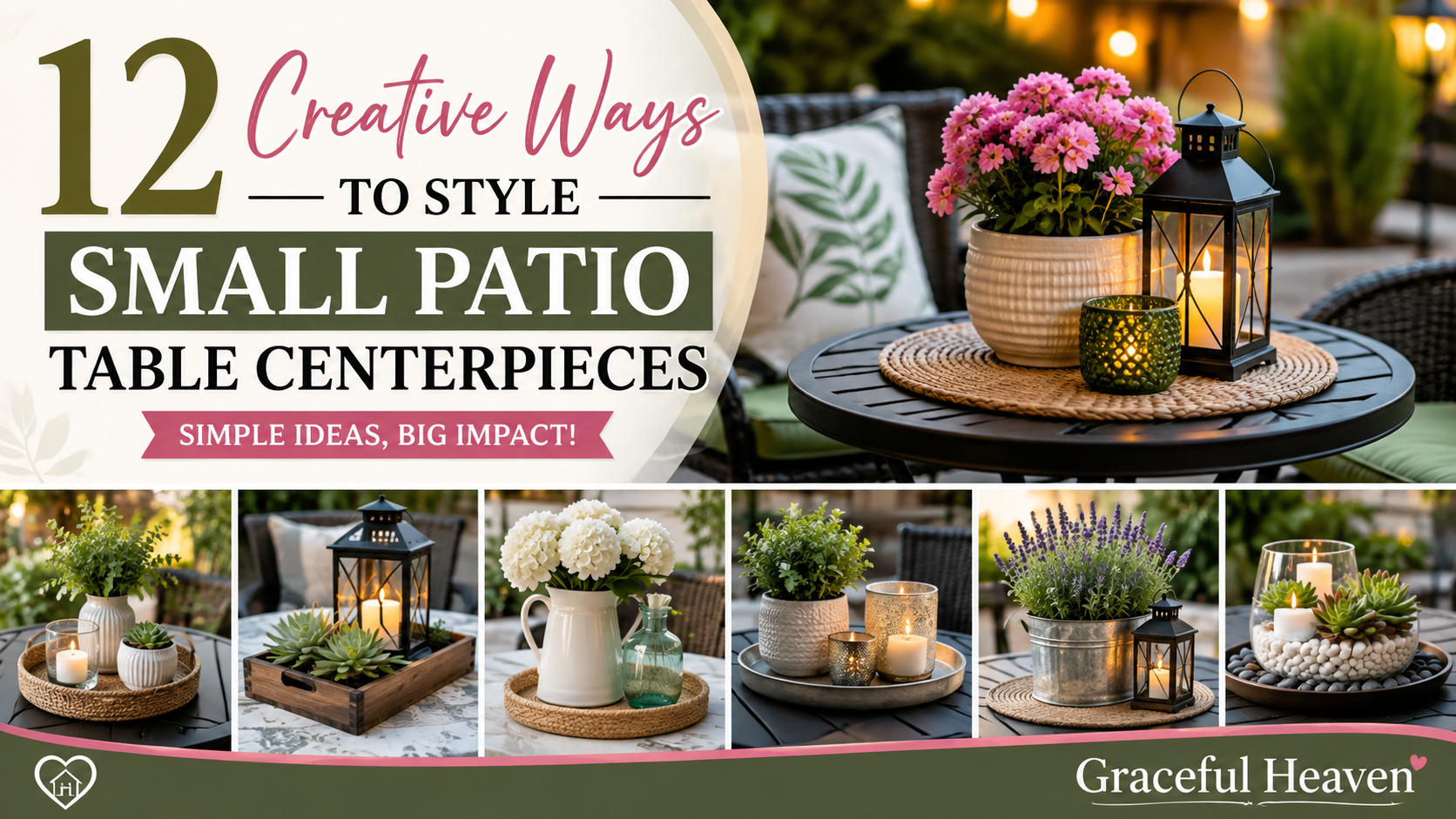
Your patio table is small. Maybe it seats two. Maybe it’s the little bistro set wedged between a railing and a potted fern. Either way, you’ve probably stood over it holding a candle or a mason jar, wondering if it looks put-together or just… there. 🤔
Here’s the thing about small spaces: they don’t forgive clutter. A centerpiece that would look charming on a six-foot farmhouse table can swallow a 24-inch patio table whole. So the real skill isn’t decorating. It’s editing.
We’re going to walk through twelve ways to make that tiny tabletop feel intentional, warm, and a little bit magical, without turning it into a fire hazard or a plant graveyard by August. Grab your coffee. Let’s get into it. ☕
1. Go Low and Wide, Not Tall and Narrow
Small tables have one big enemy: height. A tall vase or a stack of candles blocks sightlines across the table, and suddenly you’re playing peekaboo with your dinner guest through a bouquet.
Instead, think low and horizontal. A shallow dish with floating candles. A wide, flat tray with three small succulents lined up in a row. Anything under 6 inches tall keeps conversation flowing and keeps the table feeling open rather than boxed in. 🌿
Picture this: two friends, iced tea, a warm evening. If the centerpiece is a foot tall, they’re leaning sideways to make eye contact. Lower it, and suddenly the whole scene relaxes.
2. Use a Single Statement Bloom Instead of a Bouquet
You don’t need a full arrangement. Honestly, one gorgeous flower in a slim bud vase can do more work than a crowded bunch ever could.
A single peony. One stem of ranunculus. A dahlia that’s practically showing off on its own. Small tables reward restraint, and a solitary bloom reads as curated, not cheap. It’s the difference between a whisper and a shout, and on a tiny table, whispers win. 🌸
Try rotating the flower weekly. It costs almost nothing, keeps things fresh, and gives you an easy excuse to visit the farmers market.
3. Build a Mini Terrarium World
This one’s for the plant people. Tiny glass domes or open-air terrariums with moss, a few pebbles, and a small succulent create an entire little ecosystem that fits in your palm.
The trick is scale. Everything inside should feel proportional to a dollhouse, not a garden bed. Think tweezers, not trowels. Once it’s set up, a terrarium basically takes care of itself for weeks, which matters if you’re the type who forgets to water things (no judgment). 🪴
4. Layer Candlelight at Different Heights
Symmetry is boring. Instead of three matching candles in a straight line, try mismatched heights: a short votive, a medium taper, and a stubby pillar candle grouped together like they’re having a conversation.
Group odd numbers. Threes and fives feel more natural than pairs. And skip anything scented if you’re eating outside; you don’t want vanilla wax competing with your grilled peaches. 🕯️
At dusk, this kind of layered candlelight throws shadows that a single flame just can’t. It’s a small trick, but it changes the whole mood of the table.
5. Repurpose Kitchen Items as Vases
Mason jars are fine. But have you tried a small espresso cup? A vintage creamer pitcher? Even a shot glass holding a single sprig of rosemary?
Raiding your kitchen cabinets is basically free decorating. It also gives your table a personality that a store-bought vase never will, because nobody else has your grandmother’s chipped sugar bowl sitting on their patio. That’s the point. Unique beats matching, every time.
6. Go Seasonal With Foraged Elements
Skip the florist entirely some weeks. Walk your yard, or even your neighborhood, and gather what’s already there.
- Spring: a few sprigs of cherry blossom or lilac
- Summer: lavender stems, or three lemons piled loosely
- Fall: small gourds, acorns, a single maple leaf tucked under a candle
- Winter: sprigs of rosemary, pinecones, a slice of dried orange
Foraged centerpieces cost nothing and change constantly, which means your table never looks stale. It also feels a little more honest, like the outside is quietly sneaking back onto the table. 🍂
7. Play With a Color-Blocked Runner Instead of a Vase
Sometimes the centerpiece isn’t an object at all. It’s a strip of fabric. A narrow table runner in a bold color, laid diagonally across a small round table, can do the visual heavy lifting on its own.
Add one tiny object on top, maybe a single candle or a smooth stone, and you’re done. This works especially well if your patio furniture is neutral and needs a jolt of color without adding more stuff to an already-tight surface.
8. Use Fruit as Decor (Yes, Really)
A small wooden bowl with three or four lemons. A cluster of figs on a little plate. Fruit is sculptural, it smells incredible in the heat, and unlike flowers, you can eat it when the party’s over. 🍋
This works especially well for brunches or casual weekend hangs. There’s something disarming about fruit as a centerpiece; it doesn’t try too hard, but it always looks intentional.
Bonus: nobody’s allergic to a lemon.
9. Anchor the Table With a Textured Base
Before you even add flowers or candles, think about what sits underneath. A woven placemat, a slab of raw wood, a piece of slate. Texture does a lot of quiet work.
On a small table, this base becomes almost as important as whatever sits on top of it, because it defines the “stage” for everything else. Skip the base, and even a lovely centerpiece can feel like it’s floating aimlessly.
10. Go Monochrome for a Calm, Cohesive Look
Pick one color family and stick to it. All white blooms. All terracotta tones. All soft green foliage with nothing else competing for attention.
Monochrome centerpieces read as sophisticated because your eye doesn’t have to work to process them. It’s restful. And on a small table, where every inch matters, a calm palette keeps the whole setup from feeling busy or chaotic. 🤍
11. Add Movement With Trailing Greenery
Instead of everything sitting stiffly upright, let something spill over the edge. A small pot of trailing ivy, or a sprig of jasmine draped casually off the side of a low dish.
This softens the whole table. Straight lines and upright stems can feel a little rigid, almost like a display at a store. A trailing element breaks that up and adds a sense of ease, like the plant just grew there naturally.
12. Make It Functional, Not Just Pretty
Here’s a thought: what if your centerpiece actually did something?
A small caddy with olive oil, salt, and pepper, styled with one flower tucked in beside it. A little herb pot of basil that you snip mid-meal. A citronella candle that also happens to look gorgeous once the sun goes down. 🌼
Function and beauty aren’t opposites. On a small table especially, dual-purpose pieces save space and give your centerpiece a reason to exist beyond looking nice for five minutes before dinner gets served.
A Few Quick Rules to Keep in Your Back Pocket
Before you run off to rearrange your patio table, a few things worth remembering:
Keep it under a third of the table’s surface. Anything bigger starts eating into elbow room, and nobody enjoys dinner with their arms pinned to their sides.
Match the vibe to the occasion. A romantic dinner for two calls for candlelight. A Sunday brunch calls for fruit and sunshine. Don’t overthink it, but do let the moment guide the object.
And don’t forget wind. Patios are outside, obviously, but it’s easy to forget that a gust can send petals, napkins, and lightweight decor flying mid-meal. Weighted bases and low profiles aren’t just stylish, they’re practical. 💨
Small Table, Big Personality
None of this requires a big budget or a trip to a specialty store. Most of these ideas use things you already own: a teacup, a lemon, a candle stub, a handful of leaves from the yard.
What actually makes a centerpiece work isn’t the price tag. It’s whether it fits the scale of the table and says something about the people sitting around it.
So next time you’re setting up for a quiet evening outside, skip the big bouquet. Pick one small, honest object, place it with a little care, and let the rest of the table breathe. Your patio, and whoever’s sharing it with you, will thank you. ✨