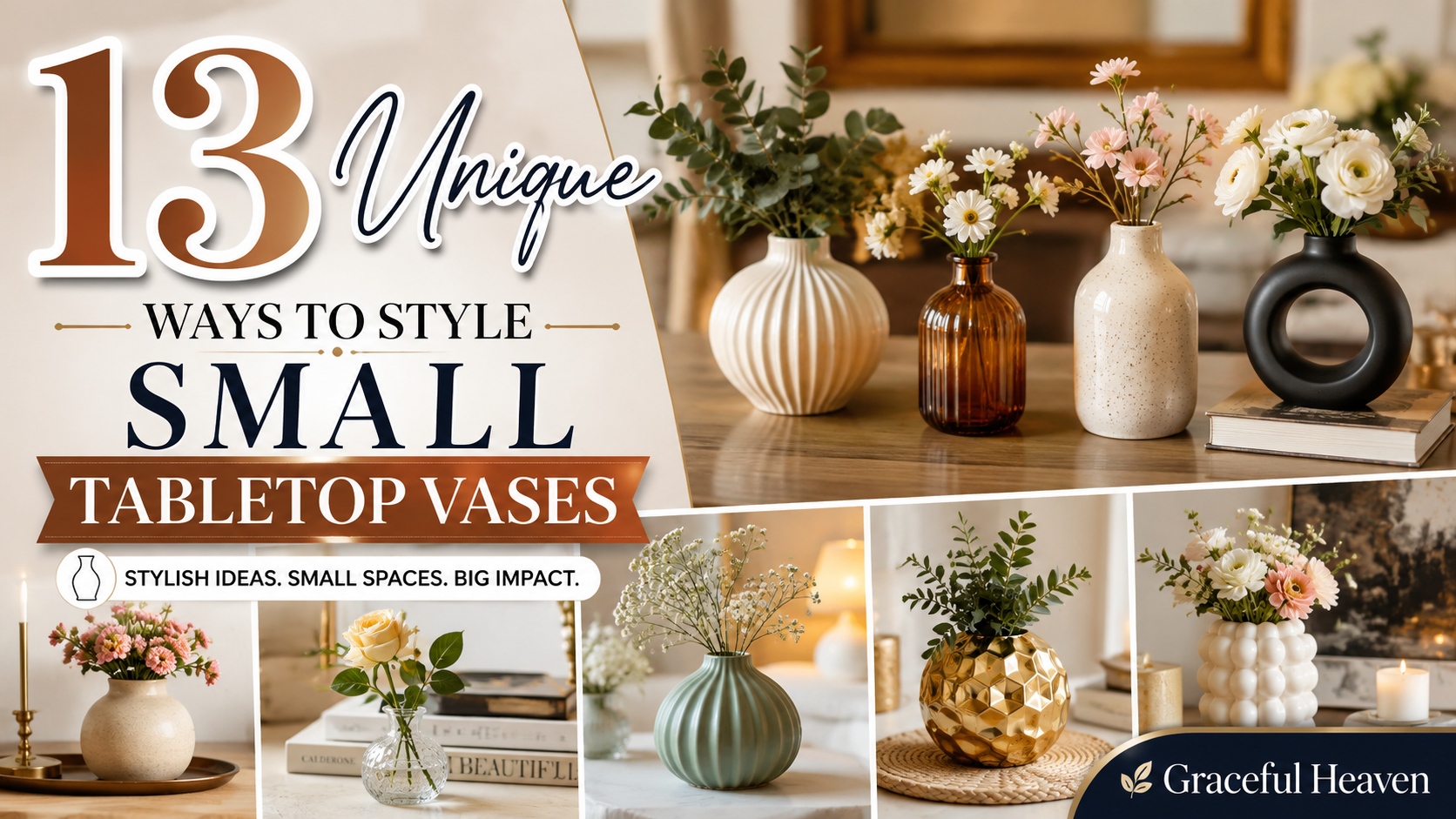
Empty tabletops are lonely places. 🌿 A bare console, an untouched nightstand, a kitchen windowsill with nothing but a dish towel — they all read as unfinished, even in a well-decorated home. One small vase can fix that in about ninety seconds, but most people stop there. They grab a single glass vessel, drop in a grocery-store bouquet, and call the job done. That’s the missed opportunity. Small vases carry real design weight once you start treating them like tools instead of afterthoughts, mixing heights, colors, and textures on purpose. We’ve gathered thirteen ways to make those little vessels earn their spot on your table. Some take five minutes. Others ask you to rethink a whole shelf. Every single one works with stuff you probably already have lying around the house — no shopping trip required, just a little imagination and maybe a rummage through your kitchen cabinets.
1. Cluster Them in Odd Numbers
Odd numbers just look better together. It’s not superstition — it’s how our eyes read a grouping. Three vases at different heights feel intentional; two feel like you ran out of ideas, and four starts to feel like a set you bought without thinking. Try a 4-inch ceramic bud vase, a 7-inch glass cylinder, and a squat 3-inch brass pot, clustered on one end of a console table. 🌸 Fill one with a single eucalyptus stem, leave one empty, and tuck baby’s breath into the third. The empty one matters here — it gives your eye a place to rest. Without it, the grouping turns into visual noise instead of a composition. Five vases works too, especially on a longer dining table or a wide mantel, where three would look sparse and lost in all that surface area. Just resist the urge to make everything match. A brushed brass pot next to a rough stoneware cup next to smooth glass gives the cluster texture, and texture is what separates “arranged” from “accidental.” Push the tallest piece slightly off-center rather than dead in the middle, too — perfect symmetry tends to read as stiff, while a slight offset feels more like something you’d actually stumble into in a friend’s home. Odd counts, mixed materials, one deliberate gap. That’s the whole formula, and it works on a bookshelf just as well as it works on a dining table.
2. Mix Heights on a Floating Shelf
A floating shelf in a hallway or above a sofa is basically begging for a height game. Line up three vases — say, a 4-inch terracotta pot, a 7-inch fluted glass vessel, and an 11-inch tapered ceramic piece — and don’t space them evenly. Push two close together and let the tallest one stand slightly apart. That gap does something interesting: it creates tension, and tension keeps a shelf from looking staged. Stack a couple of hardcover books beneath the shortest vase to fake even more height variation without buying anything new. 📚 For blooms, ranunculus works beautifully in the short vessel, while a few bare olive branches in the tall one add movement without demanding much water or maintenance. If the shelf sits near a window, morning light will throw soft shadows across the wall behind the vases, which is honestly half the reason this setup looks so good in photos. Rearrange the trio every few weeks — swap which vase holds the branches, which one goes empty — and the same three objects will feel new again. 🌿 A narrow shelf, the kind you’d find above a radiator or beside a doorway, actually benefits from this trick more than a wide one does, since there’s less room to hide an awkward gap. Just don’t crowd all three vases dead center; push the grouping toward one end and let the rest of the shelf breathe.
3. Go Monochrome
Sometimes restraint wins. Match your vase color to your blooms — white ceramic with white ranunculus, or a terracotta pot with dried wheat stalks — and the whole arrangement reads as one calm object instead of three competing ones. It’s a quiet trick. 🤍 Try it on a bedside table where you want visual peace, not a statement piece. A gray stone vase with dusty miller works the same magic in a study.
4. Use Unexpected Vessels as Vases
Not every vase needs to come from a vase aisle. A chipped vintage teacup holds three stems of lily of the valley just fine, and honestly looks more charming for the chip. Mason jars are the obvious choice, but push further: an empty olive oil tin, label peeled off, makes a rustic holder for wildflowers on a kitchen island. A brass moscow mule cup, the kind gathering dust in your cabinet, adds unexpected shine next to a stack of cookbooks. Old apothecary bottles — the small amber ones from the pharmacy aisle at flea markets — look incredible lined up with single stems in each, almost like a tiny science experiment gone beautiful. This approach costs you nothing if you’re willing to raid your own cupboards first. It also solves a real problem: matching vase sets can feel sterile, while a shelf of mismatched containers tells a story about what you’ve collected over the years. Even a coffee tin, scrubbed out and wrapped once around with twine, holds up surprisingly well against a bundle of dried grasses. Before buying a new vase for your next project, spend ten minutes checking your kitchen cabinets, your grandmother’s old teacups, even that drawer of takeout containers you swore you’d reuse someday. 🫙 Chances are good you already own three or four objects that could hold water and look intentional doing it.
5. Play with Negative Space
A single stem in a tall, narrow vase does more than a full bouquet sometimes can. Put one anemone in a slim 10-inch glass tube on a nightstand and let the empty space around it breathe. Minimalism isn’t about having less — it’s about making the little you have impossible to ignore. A single stem also means one less thing to maintain, which counts for something on a busy week.
6. Create a Windowsill Herb-and-Bloom Row
Your kitchen windowsill is prime real estate, and most of us waste it on a lone succulent that’s been dying slowly since March. Instead, line up a row of small jars — jam jars work perfectly — alternating fresh herbs like basil and mint with a few cut daisies or sweet peas. The herbs earn their keep functionally; you’ll actually snip basil for pasta on a Tuesday night. The flowers earn their keep visually, softening what would otherwise look like a science shelf. 🌼 Keep the jars roughly the same size so the row reads as a unit rather than a jumble, and rotate the water every two or three days so nothing gets murky. Morning sun through the window will do most of the styling work for you. If your sill is narrow, skip the jars altogether and use small tin cans instead — they’re lower profile and leave more room for actually cooking without knocking something over.
7. Pair Vases with Candles for Texture
Vases alone can feel a little flat on a dinner table, so bring in taper candles for contrast. Set a short bud vase next to a tall brass candlestick, and suddenly you’ve got two different textures and two different heights working together instead of one. Try pairing a matte black ceramic vase holding a single dahlia with a cream taper candle — the color contrast does a lot of heavy lifting. 🕯️ Wax and petals are both organic, both a little imperfect, and that’s exactly why they sit so well side by side. For a dinner party, run this pairing down the center of the table every foot or so; it reads as effortless even though you planned every inch of it. Alternate the order as you go — vase, candle, candle, vase — instead of a strict back-and-forth pattern, since a totally predictable rhythm can start to feel like a factory line rather than a table someone set with care. If you’re worried about height blocking conversation across the table, keep both the vases and the candlesticks under eight inches; anything taller and your guests will be leaning sideways to see each other by dessert. Unscented candles matter here too, since a heavily perfumed taper will fight with whatever’s actually on the plates.
8. Let One Vase Be the Centerpiece, Not a Crowd
Sometimes the boldest move is restraint. Skip the cluster entirely and let one striking vase carry the whole table by itself. Pick something with real presence — a deep cobalt glass vessel, or a chunky hand-thrown stoneware piece with visible fingerprints in the clay — and place it dead center on your dining table. Fill it with three stems of amaryllis, or a single oversized peony if it’s spring, and resist the urge to add anything else nearby. No candles, no scattered petals, nothing competing for attention. This works especially well when your dinnerware is already patterned or your tablecloth has some personality; a busy table needs one calm anchor, not five small distractions fighting for the same eye contact. The trick is scale. A tiny 4-inch vase will look lost and accidental in the middle of a six-foot table, so size up — go at least 9 or 10 inches tall if it’s flying solo. Think of it less like a flower arrangement and more like a piece of sculpture that happens to hold water. 🏺 We’ve seen this go wrong exactly one way: someone picks the bold vase, then loses their nerve and surrounds it with candles and place cards anyway. Trust the single piece. If it’s doing its job, the table won’t feel bare — it’ll feel edited, which is the whole point.
9. Match Vases to Your Dinnerware for Table Settings
For dinner parties, treat your vase like part of the place setting instead of a separate decision. If your dinnerware is sage green stoneware, pick up a small sage-toned bud vase and set one at every other place setting, each holding a single ranunculus or sprig of rosemary. It reads as coordinated without looking like a matching set from a catalog. This trick works especially well with mismatched vintage plates too — grab varied vases in a shared color family, like terracotta and rust, and the whole table feels curated even though nothing technically matches. Think in terms of undertone rather than exact shade. A blush-pink vase won’t match a dusty-rose plate perfectly, and it doesn’t need to; they’re close enough family that your eye reads them as coordinated instead of clashing. Save the exact matches for special-occasion china, where precision actually reads as effort rather than caution.
10. Add Dried and Preserved Stems for Longevity
Not everyone has a green thumb, and that’s fine — dried and preserved stems solve that problem completely. Pampas grass in a tall floor-adjacent vase lasts a year with zero water. Bunny tail grass, dried lavender bundles, and preserved eucalyptus all hold their shape and color for months on a bookshelf or bathroom counter without wilting, browning, or dropping petals on your furniture. 🌾 The upfront cost runs a little higher than a grocery-store bouquet, sure, but you’re not replacing it every five days either, so it evens out fast. Try a mix in one vase: three stems of dried lavender for color, a few pieces of bunny tail for texture, and one tall pampas plume for height. Set it somewhere it won’t get knocked around, since dried stems are more brittle than fresh ones. This option is genuinely the best choice for renters, frequent travelers, or anyone who’s killed one too many bouquets by simply forgetting they existed. A quick dust with a soft cloth every month or two is basically the entire maintenance routine.
11. Use Color Blocking Against Your Walls
Place a cobalt blue vase against a plain white wall and watch it practically glow. Contrast is the whole game here. A terracotta vase against sage green paint reads just as strongly. Check your wall color before you buy — the vase should fight it a little, not blend in. 🎨 Neutral walls make this almost foolproof, since nearly any saturated color pops against beige or greige.
12. Rotate Seasonal Stems Through the Same Vase
Here’s a low-effort trick that pays off all year: pick one neutral vase, something like a 6-inch cream stoneware bud vase, and just keep it. Rotate what goes inside based on the season instead of buying new vessels every few months. Tulips or daffodils in spring, sunflowers or zinnias through summer, a few dried branches or bittersweet vine in fall, sprigs of pine or eucalyptus once winter hits. The vase becomes a kind of constant in your home, a small marker of what month it actually is, which sounds sentimental until you notice how much you start looking forward to the next swap. It also saves money — one solid vase, purchased once, does the job of four seasonal purchases. Keep it somewhere visible, like a hallway table you pass every day, so the changes actually register instead of getting ignored on some back shelf. 🍂 Snap a quick photo each time you switch it out, and by December you’ll have a strange little year-in-review made entirely of flowers.
13. Group by Theme on a Gallery Ledge
Picture ledges aren’t just for framed photos. Slide a few small vases into the lineup between the frames, and suddenly the whole wall feels layered instead of flat. Pick a loose theme to keep it cohesive — coastal works well, with sea-glass blue bottles and a scrap of dried coral tucked into one vessel. A botanical theme might mix terracotta pots with dried ferns and small brass vases holding single stems. Vary the vase heights so nothing lines up too perfectly; a little imperfection here reads as curated, not careless. This is a great option if you’re short on flat surfaces but have a wall to spare, and it turns a fairly ordinary gallery wall into something people actually stop and look at. 🖼️
Your tabletop doesn’t need a florist’s budget to look intentional. Start with one idea this week — maybe just swap that lone glass vase for three mismatched ones from your own cabinets — and watch how much the room shifts. Once you notice what a two-dollar thrifted jar can do sitting next to a forty-dollar ceramic piece, you’ll start eyeing every empty surface differently: the back of a bookshelf, the edge of the bathtub, that awkward gap by the front door. Small vases are cheap experiments with big payoffs, and none of them require a redesign or a weekend of work. Try one tonight. Move a vase three inches to the left, add a stem you’d normally overlook, or finally use that teacup sitting in the back of the cabinet. Keep experimenting, and your rooms will keep surprising you. 🌼